Flooded Garage Door Motor? What to Do After a Brisbane Flood
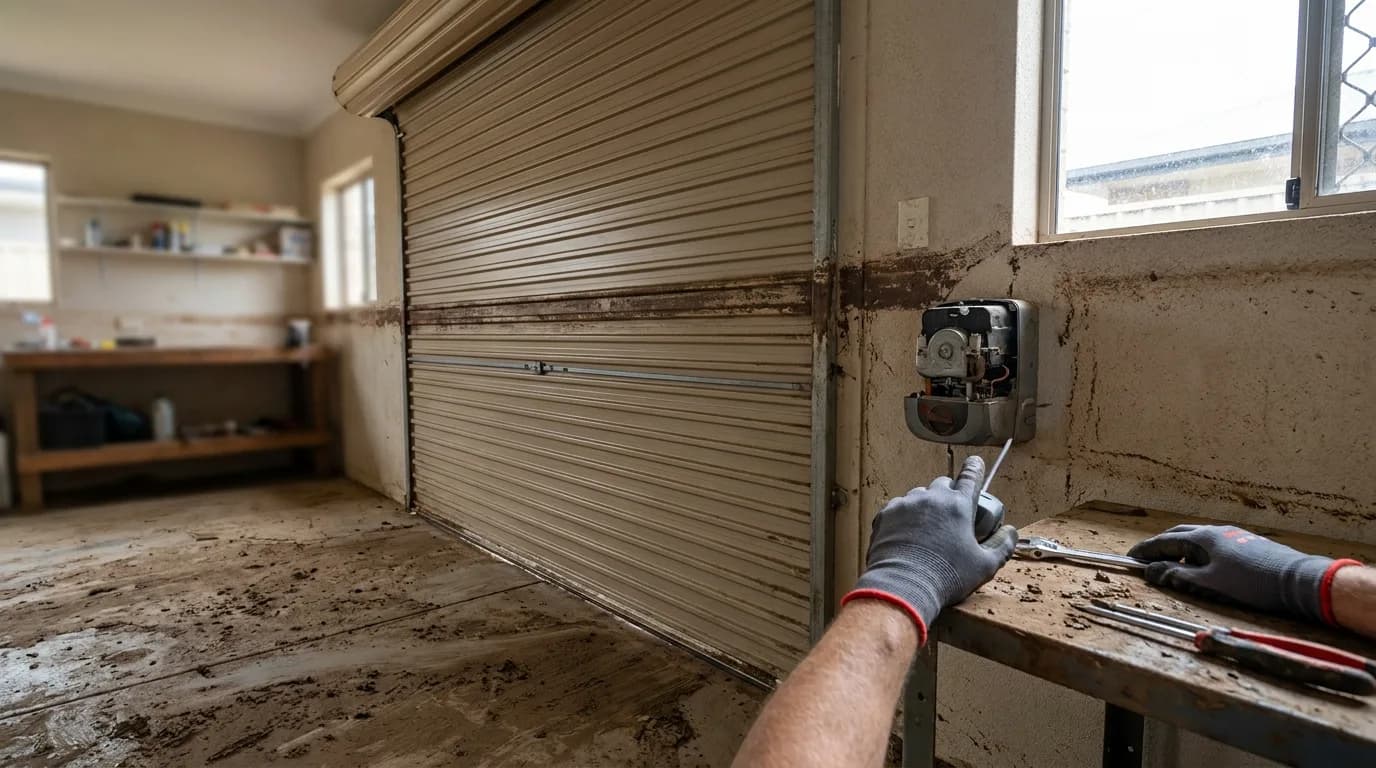
The water's gone down. There's a brown line across the inside of your door, silt drying on the slab, and a motor still bolted to the ceiling where it always was. Everything in your head says press the button and find out. Please don't.
Brisbane has done this twice in living memory at scale, and plenty of times since in smaller doses. In 2011 and again in 2022 the water came through West End, Milton, St Lucia, Jindalee, Sherwood and Goodna, and in every one of those events a large number of garage door motors went under. We've replaced a lot of them, and we've also seen what happens to the ones people tried to save. This is what we've learned.
Has your motor actually been underwater?
Establish this before anything else, and be honest about it, because the answer changes everything.
In a lowset garage the head unit sits at ceiling height, so it only goes under when the water gets seriously high. But look for the waterline on the walls and on the inside of the door, and check whether it's above the bottom of the unit. Then check the outlet the motor is plugged into, which is sometimes lower than you'd think. And check for a wall-mounted unit — on a lot of roller doors the motor sits beside the door at head height rather than on the ceiling, which puts it under long before a ceiling unit is touched. Silt lines don't lie: if there's a tide mark on the housing, it went under.
If it did, here's the rule, and it's not a soft one. Do not switch it on. Do not press the button to see if it works. Isolate that circuit at the switchboard before you go near the unit, and have an electrician check the circuit before anything is re-energised. Mains voltage, a wet control board and a motor winding full of conductive silt is a genuine shock and fire risk, not a caution label. The circuit itself is an electrician's job — the motor is ours.
Why can't a flooded motor just be dried out?
This is the question we get every time, and it's a fair one. It seems reasonable. Water evaporates. Give it a fortnight in a Brisbane summer and surely it's fine?
The problem is that floodwater isn't water. It's a slurry of silt, sewage, hydrocarbons off the roads, garden chemicals, and — because the Brisbane River is tidal — a brackish component that carries salt well upstream. In West End and Milton, what came through the door was not creek water. When that dries, the water leaves and everything else stays.
So here's what's still in your motor a fortnight later. A conductive residue of salts and silt sitting across a control board, bridging tracks that were designed to be micrometres apart and dry. Grit packed into relay contacts. Moisture wicked under the conformal coating that's supposed to protect the board, now trapped against it rather than kept off it. Corrosion running on the transformer windings, on the RF receiver stage, in the limit switch mechanism, and in the motor windings and bearings themselves. Every one of those is invisible and every one of them is progressing.
And the failure mode is the reason we're firm about it. A flooded motor rarely dies on the spot — it works. For a week, or a month, or a season. Then it starts doing things at random: opening on its own, refusing at 2am, stopping mid-travel, ignoring the limits. An intermittently faulting motor on a door that weighs what yours weighs is not a machine you want in a house with kids in it. A submerged unit gets replaced, not resurrected. That's the honest answer even though it's the more expensive one, and it's what our garage door motor team will tell you on-site.
What about the door itself?
Your door sat in that water for hours, and it collected everything that was in it.
The immediate problem is silt, and specifically silt in the guides and tracks. That mud is abrasive — it's sand and grit with clay holding it together. Run the door with silt in the guides and you take a grinding paste to the coating on your curtain and the inside of your guide, in one pass. A door that came through the flood structurally fine can be ruined in a single cycle by being operated before it's washed out.
So before that door runs again: flush the guides and tracks out with fresh water, get the mud out from under the bottom rail and behind the bottom seal, and hose both faces of the curtain. The salt component matters too — for a door in a tidal reach, floodwater has left a chloride deposit on steel, and that behaves exactly like the salt air problem on the bay side: a hygroscopic film that holds moisture against the metal long after everything looks dry.
What happens to springs, cables and bearings?
This is the part nobody thinks about, and it's the part with teeth.
Springs corrode from the surface inward, and a pitted spring is a shortened spring — every pit is a stress riser, and springs break at stress risers. A spring that sat submerged in silty, brackish water has been given years of corrosion in an afternoon, and it will not tell you about it. It'll just fail early, one night, with a bang.
Lift cables are worse, because they're stranded steel. Water and silt wick between the strands by capillary action and sit in there rotting the cable from the inside, where you cannot see it. A flood-affected cable can look completely serviceable from the outside and have very little left. And bearings — shaft bearings, roller bearings, barrel bearings — hold grit indefinitely and grind themselves out.
So a post-flood door needs the whole tensioned side inspected properly, and after a long submersion, replacing springs and cables is very often the honest answer rather than the cautious one. What it absolutely doesn't need is you having a look at it. Every warning in why springs are the one repair you should never DIY applies double to a component whose real condition is now hidden under corrosion. That's a spring and cable job.
What should you photograph before anything is touched?
Do this first, before you clean, because you only get one chance and cleaning destroys the evidence.
- The waterline. On the wall, on the inside of the door, and — critically — on the motor housing itself.
- The head unit in place, from a distance and up close, with the silt line visible.
- The outlet and any wall-mounted controls that went under.
- Silt in the guides and tracks, before you flush them.
- Mud packed under the bottom rail and around the bottom seal.
- Wide shots that put the whole garage in context, so the height of the water is unarguable.
We can document the damage and the cause as part of the job. What your policy covers is between you and your insurer, and we're not going to guess at it — but we can make sure the damage is recorded properly, which is the part that's actually in your control.
How do I get in and out while this is sorted?
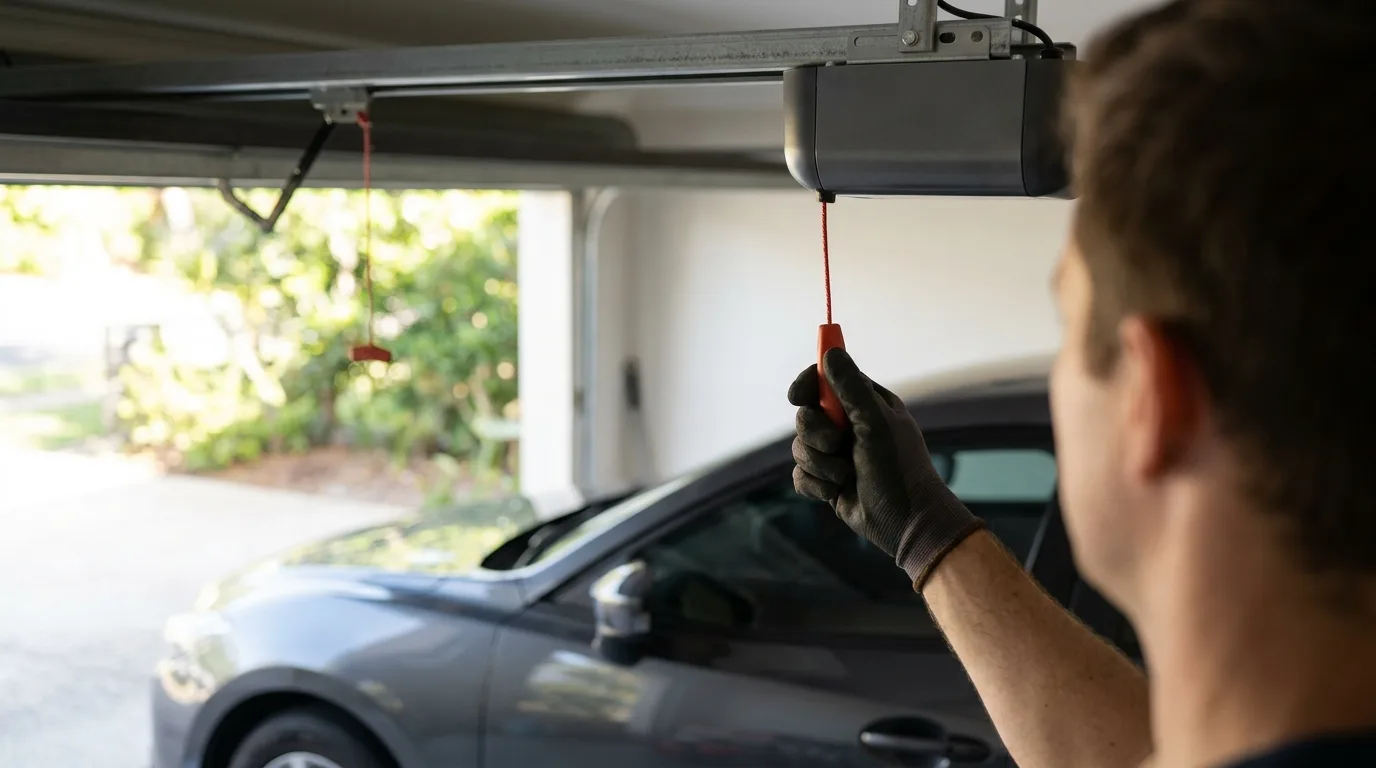
The manual release cord works with no power at all, so the door can be operated by hand — but only after you've checked the balance is still there, because everything above applies to your springs. Pull the release with the door closed and lift gently. If it comes up with modest effort, you're fine to use it manually for now. If it fights you or wants to run back down, stop, keep everyone clear and wait for us.
If the door won't close and the garage is full of everything you just dragged out of the house, that's a security problem on top of a flood, and it's exactly what our 24/7 emergency garage door service is for. If a permanent fix genuinely can't happen that day, we'll secure the opening so you're not left exposed overnight, and come back to finish it.
Can it be set up better for next time?
Partly, and it's worth saying plainly: you can't flood-proof a garage door. What you can do is make the recovery cheaper and faster, which in the flood suburbs is a real return.
Height is the main lever. A ceiling-mounted head unit is meaningfully higher than a wall-mounted unit beside the door — which is why, in Jindalee, Sherwood, Goodna and the low streets of West End and Milton, we'll often steer people away from the low-mounted option they'd otherwise choose on convenience. Where the outlet and the control wiring sit is worth a conversation too; there's usually room to move them up.
Beyond that: choose a door where the bottom section can be replaced on its own, because the bottom is what sits in the water. Battery backup is worth having, because flood events and blackouts arrive together. And an external emergency release means a closed door with no power isn't a locked door. None of it stops the water. All of it means the next event costs you days rather than weeks — and it's the kind of thing we'll work through at a new door measure-up rather than sell you off a list.
If your motor has been in floodwater, leave it isolated and call Core Garage Door. We work the flood suburbs, we know what silt does to a curtain and what brackish water does to a cable, and we'll come out and give you a free, honest on-site quote — including the parts of your door that are fine, which after a flood is a genuinely nice thing to hear.