Garage Door Won't Open? Work Through This Before You Call Anyone
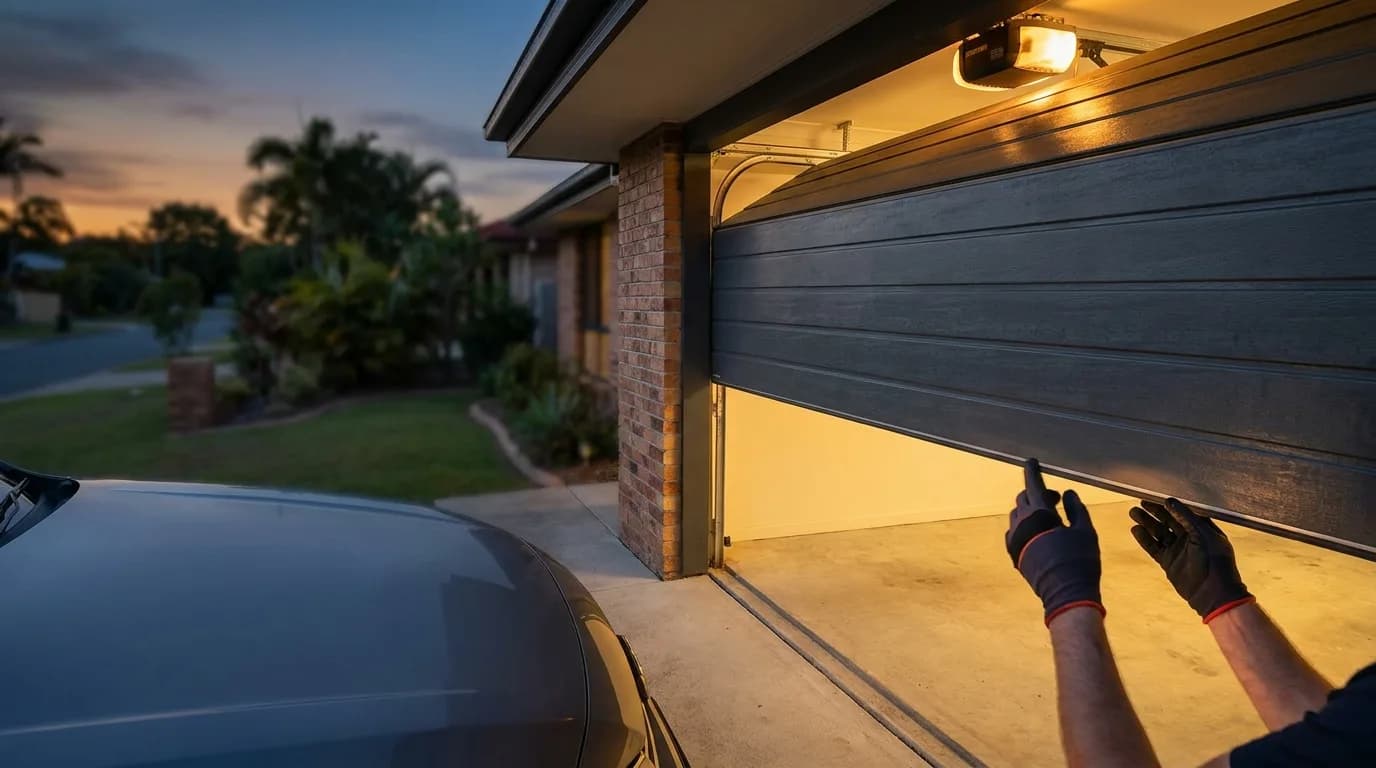
You've got somewhere to be and the door won't open. The car is on the wrong side of it, the clock is going, and pressing the button harder is not producing a different result. Before you call anyone — and before you start pulling on things — spend four minutes here. A garage door that won't open sorts itself into a handful of distinct faults, and you can tell them apart with your ears from where you're standing.
The trick is to stop asking why won't it open and start asking what does the motor do. Nothing at all? A single click? A hum with no movement? Running happily while the door sits still? Each of those points at a different part of the system, and telling us which one you've got means we arrive with the right part on the vehicle instead of a guess.
Does the motor do anything at all?
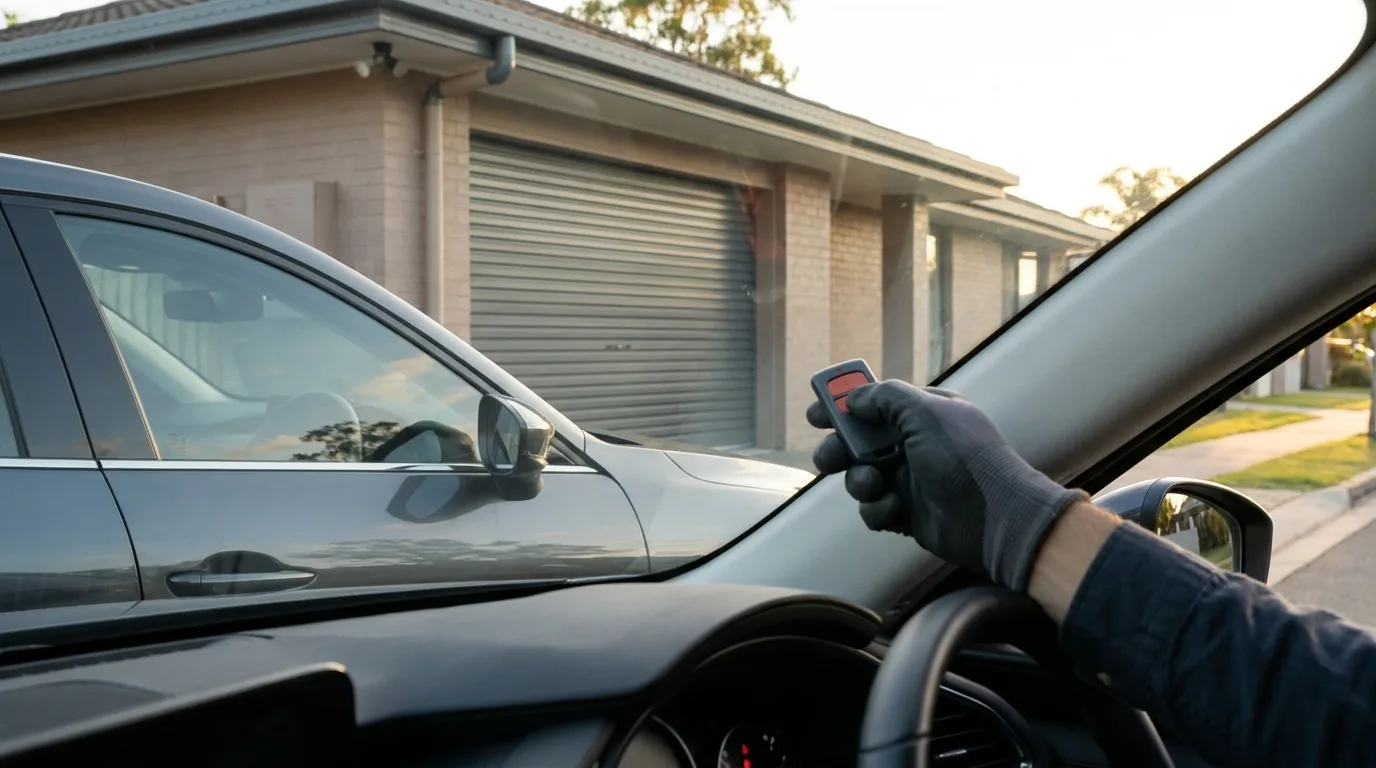
Press the wall console — not the remote — and listen. Total silence, no courtesy light, no click, means the unit has no power, and that's a good outcome because it's the cheapest fault on the list. If the light comes on and the unit clicks but nothing moves, it has power and the problem is downstream. If the remote does nothing but the wall console works, you don't have a door problem at all, you have a radio problem, and our guide to a garage door remote that only works up close covers that whole territory.
Use the wall console for every test in this article. It's hard-wired, so it takes the remote, the battery and the aerial out of the equation entirely. Half of the diagnostic value here is in eliminating variables rather than finding culprits.
Is the power actually on?
Brisbane's storm season trips safety switches constantly, and here's the catch: your garage motor is very often on its own circuit, or plugged into a ceiling outlet that shares a circuit with nothing you'd notice. The house lights work, the fridge hums, and you have no reason to suspect the switchboard — but the RCD covering that one circuit has quietly gone to off.
- Check the switchboard for a tripped safety switch or breaker, not just the main.
- Check the outlet the motor is plugged into — it's usually on the ceiling near the head unit, and a plug can be knocked out by a ladder or a stored item.
- Look for a courtesy light on the head unit. Light on means power is arriving.
- If a switch trips again the moment you reset it, stop. Something on that circuit is faulted and it needs an electrician, not another reset.
If the motor has been in floodwater at any point, none of the above applies — do not energise it and do not press anything. Go straight to our guide on a flooded garage door motor, because switching on a submerged unit is a genuine shock and fire risk.
Is the door locked?
It sounds too simple to be worth checking, and it's the reason for more call-outs than we'd like to admit. Roller doors and older sectionals commonly have a centre bolt or a pair of side locks. If somebody threw them before a trip away — or a well-meaning house-sitter did — the motor will pull against a bolted door, decide it has hit an obstruction and stop. Look at the lock. Then look at the vacation or lock button on the wall console, which disables remotes and does a very convincing impression of dead electronics.
Why does the motor hum but the door doesn't move?
This is the important one, and it's where the article changes tone. A motor that hums or strains without moving the door is a motor being asked to do something it was never built to do. Your springs, not your motor, carry the weight of that door. The motor is a nudge, not a crane. When it's straining, the usual reason is that a spring has broken and the full weight of the door has landed on the drive.
Look for a bang you might have heard earlier — often overnight, often mistaken for something falling over. Look for a visible gap in the coil of the spring on the shaft above the door; that gap is conclusive. Look for a cable hanging slack or bunched on its drum, or a door sitting visibly crooked. If you see any of it, stop pressing the button. Every attempt from here risks stripping the drive gear, burning the motor out on top of the original fault, or dragging the door off its tracks. That's a broken spring and cable replacement job, and it is genuinely not a DIY one.
A hum without movement can also be a failed capacitor or a stripped drive gear, and on a roller door it can be a barrel that has seized in its bearings. All three are ours. None of them get better with another press.
Why does the motor run normally while the door sits there?
Different sound, different fault, and this one's often good news. If you can hear the chain or belt running the full length of the rail while the door doesn't twitch, the trolley has disengaged from the drive. Nine times in ten somebody pulled the manual release during a blackout, got the car out, and never re-engaged it. On most units you re-engage by pulling the cord back toward the door or simply running the motor until the carriage clicks back onto the trolley — the specific move varies by brand, and it's in your manual.
The less cheerful version is a stripped drive gear. The main gear in a lot of chain-drive head units is nylon, deliberately, so that it fails before something more expensive does. When its teeth shear you get a motor running merrily and a door going nowhere, usually with a grinding note from inside the head unit. That's a repair rather than a whole new unit in many cases, and it's part of what our garage door motor service covers.
What if the door lifts a few centimetres and stops?
It's moving, so power and drive are fine. Something is either physically stopping it or convincing the motor that something is. Check the bottom seal isn't stuck to a wet slab — after a Brisbane downpour, a rubber that has sat in water overnight can bond to concrete surprisingly well. Check the tracks for an obstruction, and check the guides on a roller door for grit. And look hard at whether the door is lifting square: a door that starts up and immediately racks to one side has a cable or spring problem, not an obstruction.
On a roller door specifically, a door that has become progressively heavier over months and now barely lifts is a barrel spring that has lost tension. It's the classic Queensland roller door complaint, it's a re-tensioning job, and the barrel spring holds real energy — that one lives with our roller door technicians, not with you.
How do I get my car out right now?
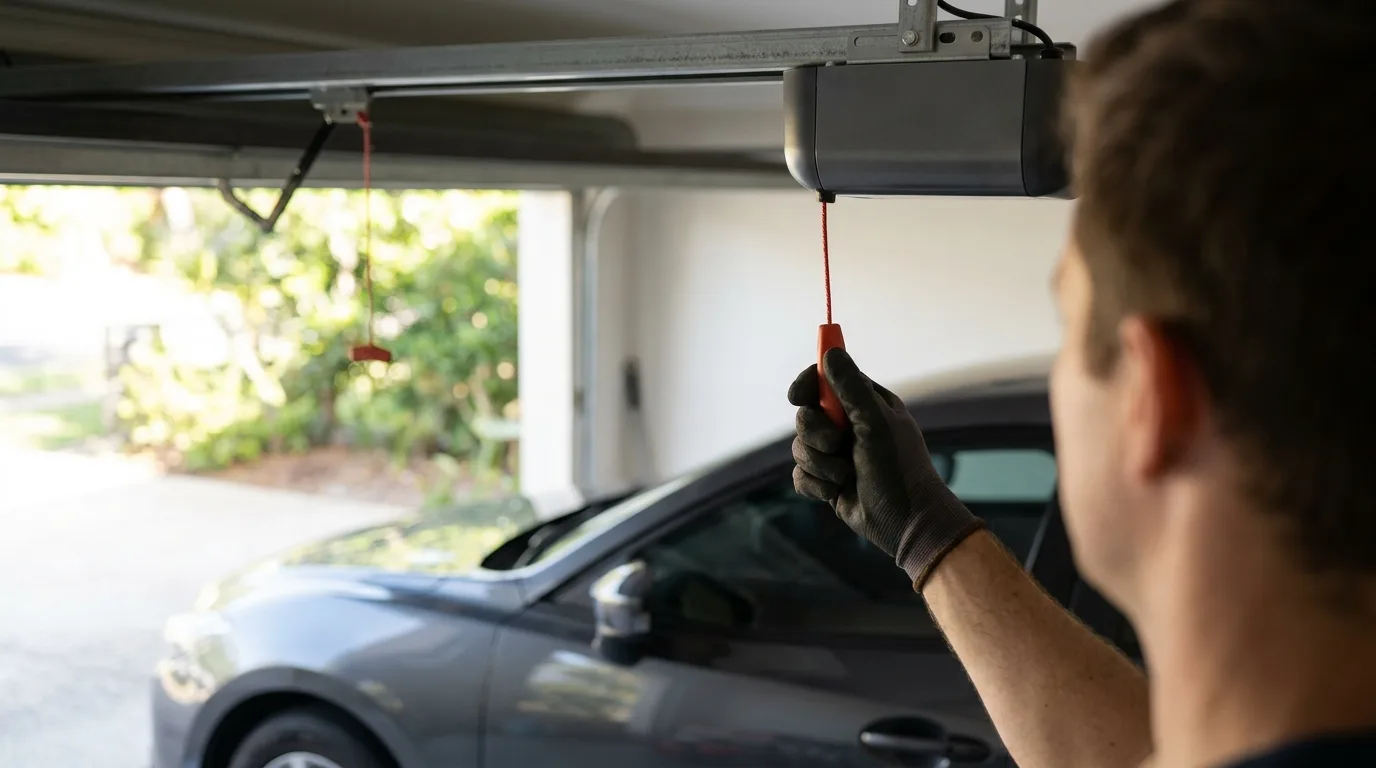
The manual release. There's a cord hanging from the motor rail with a red handle on it — pull it and the door disconnects from the drive so it can be moved by hand. Do this with the door closed, which is the position it can't fall from, and then lift gently.
Now the important part. If the door lifts with modest effort, you're fine. If it fights you, feels like lifting a fridge, or starts to run back down the moment you let go, put it down and stop. That's a broken spring holding nothing, and a heavy door with no counterbalance will come down hard on whatever is under it. No car appointment is worth that. Call us — a trapped car is exactly the kind of thing our 24/7 emergency garage door service is dispatched for.
And if you're outside with a closed door and no power at all, you may be stuck: the release cord is inside. Some doors have an external emergency release fitted through the door face for exactly this scenario. If yours doesn't, and the garage is your only way in, that's worth a conversation about battery backup — Brisbane loses power often enough in summer that it's a genuine consideration rather than an upsell.
Where do the safe checks stop?
Right here. You can check the switchboard, the outlet, the remote battery, the manual lock, the console lock button, the sensors, and the tracks for obstructions, and you can pull the release cord. You do not touch springs, cables, drums, the shaft, or the bottom brackets on a sectional door — all of which are under load whenever that door is closed, whether the power is on or not.
Work through the list, note what the motor actually does, and call Core Garage Door with that one sentence ready. We'll come to you anywhere in Greater Brisbane, diagnose it properly rather than replacing the obvious part, and quote you free before we start.