Your Garage Door Remote Only Works Up Close. Here's Why.
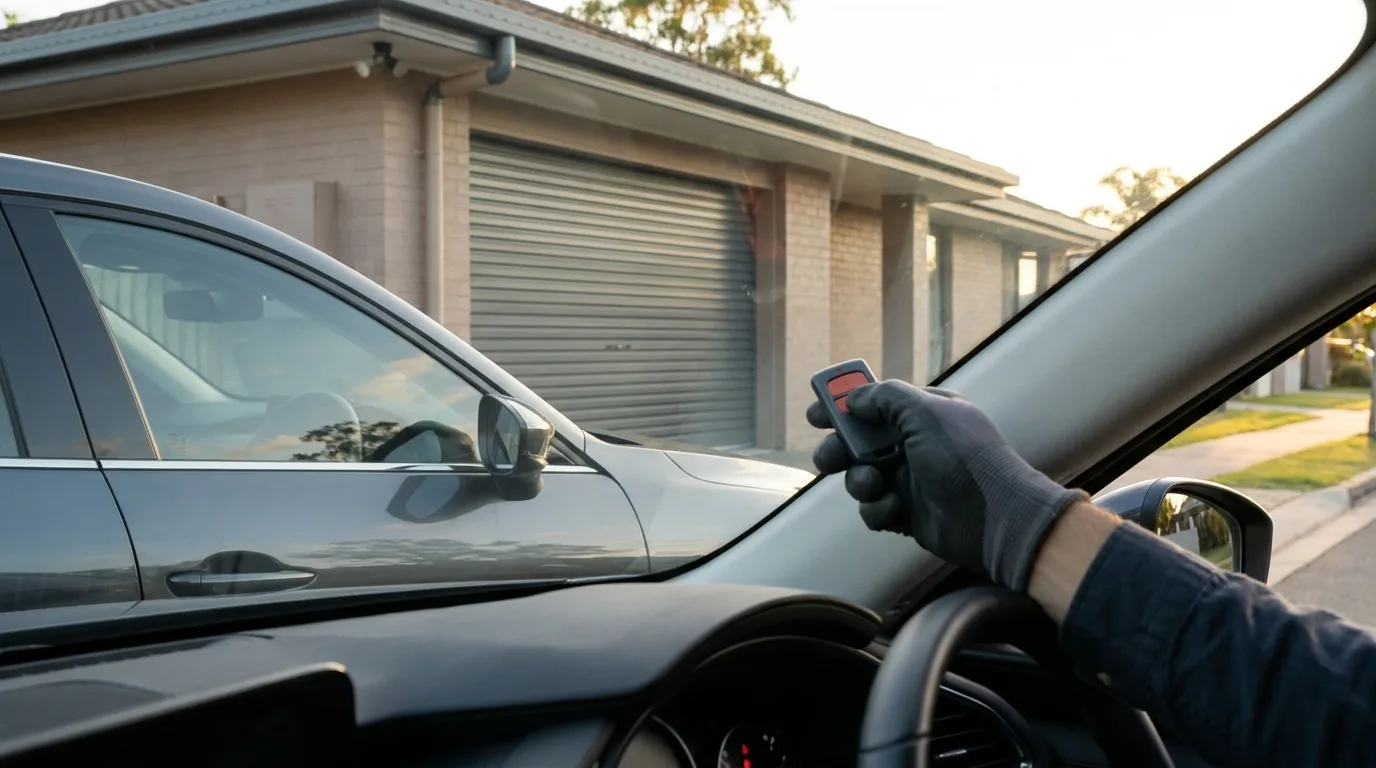
It used to work from halfway down the street. Now you have to roll to a stop in the driveway, hold the remote up near the windscreen, and press it three times before anything happens. It's not broken enough to be an emergency and it's just annoying enough to think about every single day.
Here's the good news: this specific symptom — works up close, not at range — is one of the most diagnosable faults on a garage door, and it's almost never the remote itself. Range loss means the radio link between transmitter and receiver has lost margin. Something is either transmitting weaker, receiving worse, or shouting over the top. There are only a few candidates, and you can narrow them down from the driveway.
Is it the remote, or is it the receiver?
Two tests, thirty seconds, and they split the problem cleanly.
- Does the internal wall console still work perfectly? If yes, the motor, the door and the drive are all fine. You have a radio problem, full stop — nothing mechanical is involved.
- Do you have a second remote or a keypad? If the second one has the same reduced range, the problem is at the receiver end. If only one remote is weak, it's that remote.
That's genuinely the whole fork in the road. One weak remote is a battery or a knocked transmitter. All remotes weak at once is the aerial, the receiver, or interference — and that's where most of these end up.
Do garage door remote batteries really cause this?
They cause it constantly, and the failure mode surprises people. A coin cell doesn't die like a torch battery, going from bright to nothing. It sags. As it goes flat the remote still transmits — just with less power — so the effective range shrinks steadily over weeks until you're standing at the door. Works up close only is what a dying battery looks like from the outside.
Brisbane accelerates it. A remote living in a car console spends every summer day in an oven, and heat is hard on coin cells. If yours is clipped to a sun visor, it's cooking. Change the battery first — it's the cheapest test on the list, and the type is printed on the cell itself. Most modern remotes keep their programming through a battery change; a few older systems want a quick re-pair afterwards, which is a thing we do on-site rather than something to lose an afternoon to.
Where is the aerial, and what's wrong with it?
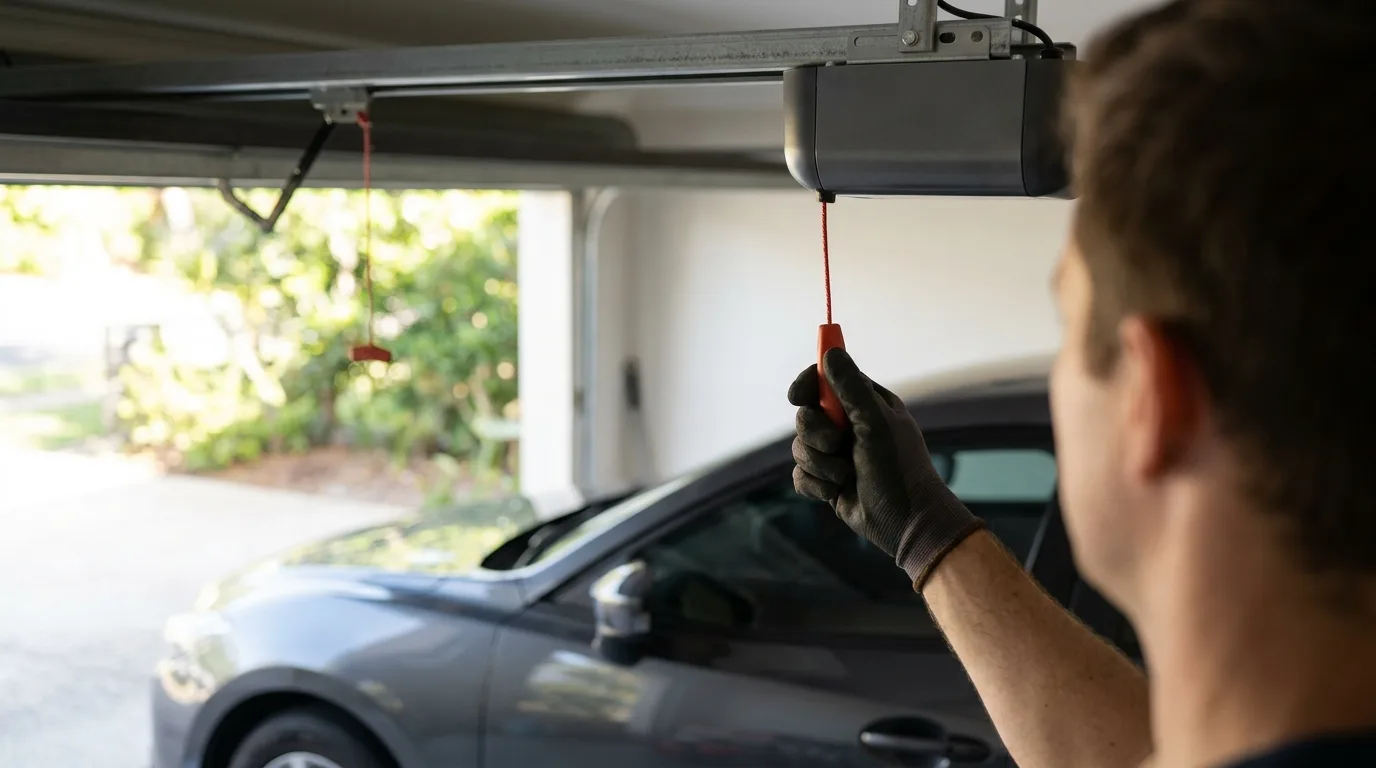
This is the number one cause and almost nobody knows it exists. Look at your motor head unit. Somewhere on it there's a thin wire, usually a few centimetres long, that's meant to hang down free and clear. That's the receiver aerial. Most Australian garage motors run in the 433 MHz band, and at that frequency the aerial's length and its position are doing real work.
What we find when we get up there is depressingly consistent. It's been coiled into a neat loop and cable-tied to the rail. It's been tucked back inside the head unit because it looked untidy. It's been stapled along a rafter. It's been pushed up into the ceiling insulation. It's been snipped shorter by someone who assumed it was a stray wire. Or it was simply never unwound from the factory coil at install. Any of those can take a remote from thirty metres of range down to two — and it degrades so gradually as things settle that nobody connects it to a cause.
The fix is genuinely as boring as it sounds: get it hanging free, straight, downward, clear of metal. It's part of every garage door motor service call we do, and it's the reason a technician can sometimes restore your range in about a minute.
Could something else be jamming the signal?
Yes, and the culprit in a modern house is usually lighting. Cheap LED lamps and their drivers are notorious for spraying radio noise across the 433 MHz band, and if that fitting is in or near the garage it's sitting right on top of your receiver, drowning out a remote that's forty metres away. The test is beautifully simple: turn the suspect lights off and try the remote from the street. If your range comes back, you've found it.
Geometry matters too. A closed steel roller door is a large metal sheet standing between you and a receiver that lives behind it — the worst possible arrangement, and it's why range often looks fine on approach from one angle and terrible from another. Metal-clad garages, foil-backed sarking and steel roof framing all do the same thing to a greater or lesser degree. None of that is a fault to be repaired; it's a reason the aerial position has to be right, because you're already starting with a handicap.
Why won't my new remote pair?
A few reasons, and they're worth knowing before you buy something online that won't work.
- Generation mismatch. B&D, Merlin, ATA and Chamberlain have all run multiple remote generations. A remote with the right badge on it is not automatically the right remote for your unit.
- Rolling codes. Modern systems change their code every press, which is exactly what makes them secure and exactly what makes a generic universal remote a coin flip.
- Receiver memory is full. Units hold a limited number of remotes. Add one too many and it either refuses or silently pushes an older one out — which is why one family member's remote mysteriously dies the week a new one arrives.
- Code drift. On some older rolling-code systems, hundreds of presses well out of range can walk the transmitter's counter away from the receiver's, and it needs a re-sync rather than a replacement.
Bring us the make and the model number off the back of the head unit and we'll code the right remote to it on-site, rather than posting you into a compatibility guessing game.
What about keypads and phone control?
External wireless keypads live outside in Brisbane weather, and humidity is what kills them — moisture gets under the membrane, and either the keys stop responding or one starts triggering by itself. If your keypad has become unreliable in the same period as your remotes, don't assume they share a cause; a keypad is its own transmitter with its own battery and its own weather problem.
Wi-Fi or smart-phone control is worth mentioning here because it sidesteps the radio link entirely — the command goes over your home network to a bridge at the head unit rather than through a 433 MHz hop from the kerb. If you're chronically fighting range in a metal-clad garage, that's a legitimate answer rather than a gadget. It's also the thing that tells you at work whether you left the door open.
When is it the receiver itself?
When every remote and the keypad all lose range at once, the aerial is hanging correctly, and nothing has changed in the lighting. Receiver boards degrade, and in Brisbane they degrade in a very specific window: storm season. A nearby strike doesn't have to hit the house to put a surge through the mains or induce one into wiring, and the RF front end is often the most delicate thing on the board. If your remotes went vague the week after a big cell came through, that's not a coincidence — and it's one of several reasons surge protection is on our storm season checklist.
That's a repair or a replacement depending on the unit and the part, and it's the kind of call where we'd rather look at it than guess over the phone. What we won't do is sell you a motor because a remote is weak.
What does a technician actually check?
In order: battery voltage under load rather than at rest, the aerial's routing and length, the receiver's response from graduated distances, the lighting circuit for noise, the remote generation against the unit, and the receiver memory. Nine times in ten it's the aerial or the battery, and we'd rather tell you that in five minutes than convert a radio problem into an invoice for garage door repairs that had nothing to do with it.
If your remote has quietly shrunk its range, or a new one won't pair, call Core Garage Door. We'll sort the radio side on-site, code your remotes and keypad while we're there, and give you a free quote before anything happens.