Storm Season Is Coming: Get Your Garage Door Ready
Every Brisbane spring, the same thing happens. The first serious cell of the season comes through on a Thursday afternoon, and by Friday morning every garage door company in the city is booked out for a fortnight. The people who get looked after quickly are the ones who thought about it in September, when nobody else was.
This isn't a scare piece. Your garage door probably came through last summer fine. But it's the largest opening in your building envelope, it's the part of your house most exposed to hail, and it's on the circuit most likely to be affected when the power goes. A couple of hours of attention before November is worth considerably more than the same attention in January.
When is storm season, and when should you prepare?
Brisbane's severe storm season runs roughly November through April, with the nastiest cells typically arriving in the late spring and early summer stretch. That's the calendar, and it doesn't move — Queensland doesn't observe daylight saving, so a 4pm storm in January is a 4pm storm on AEST just like it was in October.
Which makes September and October the window. Not because anything magical happens in those months, but because that's when a technician can come out next week instead of in three, and because a fault found in spring is a booking while the same fault found in a storm is an emergency. Pre-season servicing is the cheapest insurance in this entire article.
Why is the garage door the weak point?
This is worth understanding properly, because it's the reason the door matters structurally rather than just cosmetically.
Your house resists wind as a sealed box. The roof is held down against uplift, and the calculations that decided how it's held down assume the box stays sealed. Now put a hole in the windward wall — a garage door that fails, or bows enough to break its seal, or gets pushed out of its guides. Wind pours in and pressurises the inside of the building. Now the roof has suction pulling up from outside and pressure pushing up from inside, at the same time, and the numbers stop being the numbers anyone designed to.
That's why a garage door isn't just a big lid on your car. It's a structural element on the biggest opening in the wall, and it's the reason we get animated about guide fixings and lintel bolts on a pre-season check that a homeowner would never think to look at.
Is my door wind-rated, and does that mean cyclone-rated?
Let's be precise here, because there's a lot of loose talk in this market and some of it is designed to sell you something.
Brisbane sits in wind Region B. That is not a cyclonic region — the cyclonic classifications apply well to our north. Nobody in Brisbane is required to fit a cyclone-rated garage door, and anyone telling you otherwise is either confused or selling. Wind-rated and cyclone-rated are not synonyms and the distinction is real.
What does apply is a wind classification for your specific site, determined at build from the region, the terrain category, the shielding from surrounding buildings, and the topography. That's why two houses in the same suburb can genuinely need different doors: one on an exposed ridge in The Gap with a clear westerly run at it is a different site to one tucked between two neighbours in Ashgrove. If your door is exposed — on a rise, on a corner, facing an open paddock or a park with nothing between it and the weather — then upgrading to a door rated for that exposure is a completely legitimate conversation, and it's part of what we assess at a new door measure-up. It's an upgrade for a real reason, not a mandate.
What does hail actually do to a garage door?
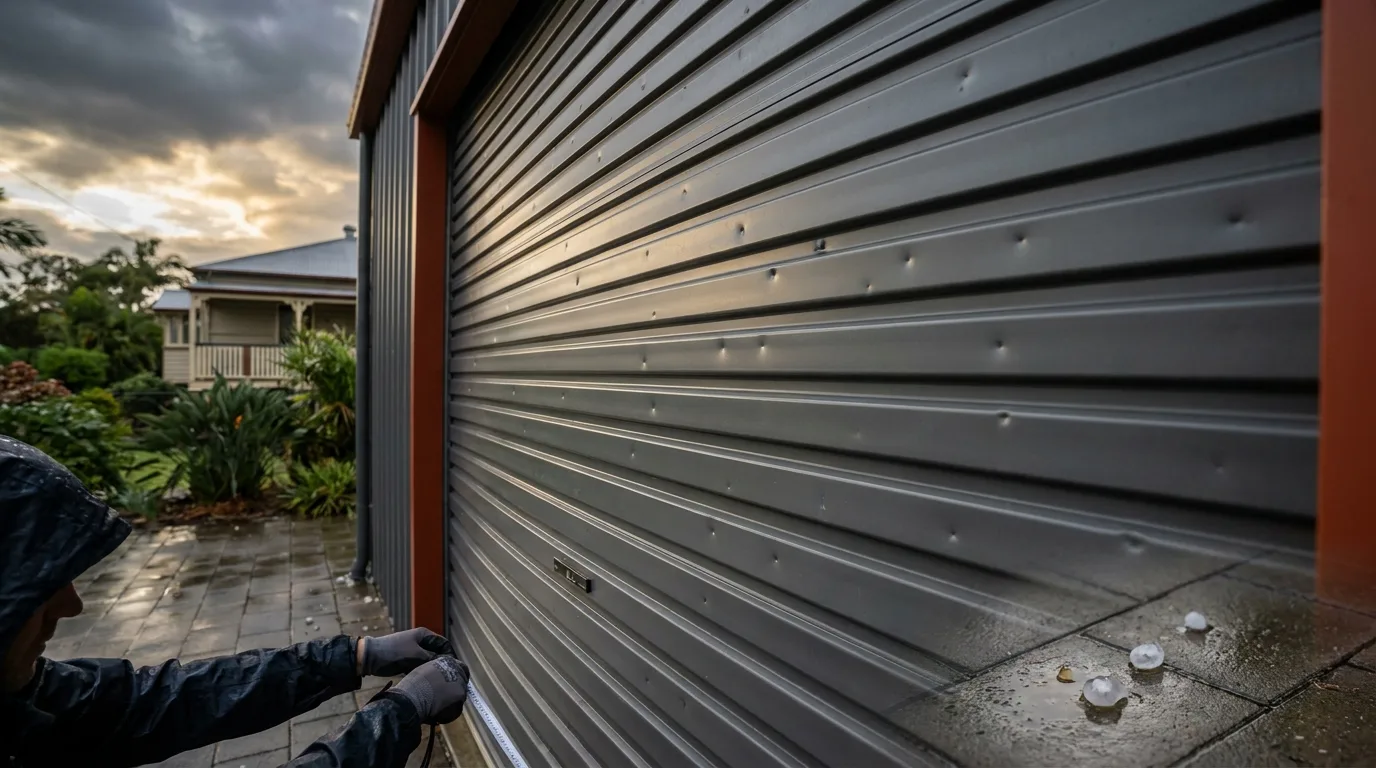
Brisbane doesn't get hail often, and then it gets hail. On 31 October 2020 giant stones came through the Springfield area and left a very long queue of damaged doors behind them. If you're in the newer estates out that way — Springfield Lakes and its neighbours — you'll know households who are still telling that story.
Here's what people underestimate. A dented roller door isn't a cosmetic problem waiting for a rainy day. A dent in a slat changes the profile of the curtain, and a curtain that's no longer flat starts to bind in the guides. The motor doesn't know it's binding — it just pushes harder, because that's what motors do. So it forces a bowed curtain up a guide it doesn't fit any more, wearing both, until the door jumps a guide and jams half open. The hail didn't break your door. It started the process that did.
Sectional doors take it differently. A hail-dented panel is often replaceable on its own, since a sectional is built from individual panels precisely so one can be swapped — but only if the profile and colour are still made. On an older or discontinued door, that panel may no longer exist, and a fresh panel in the middle of a sun-faded door rarely looks like anything but a fresh panel. That's a repair-versus-replace call we'll give you straight through our garage door repairs service.
What happens when the power goes out mid-storm?
Two separate problems, and people usually only plan for the first.
The obvious one: no power, no motor. From inside, the manual release cord handles it. From outside, with the door closed, you're relying on an external emergency release if one's fitted — and if it isn't, and the garage is your way in, you're standing in the rain. That's the case for battery backup, and in Brisbane it's a genuinely practical fitting rather than a nice-to-have. It's a standard part of what our garage door motor technicians fit.
The one people don't plan for: the surge. A strike doesn't need to hit your house to put a spike through the mains or induce one into wiring. Control boards and RF receiver stages are the delicate bits, and the classic post-storm symptom set is a door that works fine but every remote has suddenly lost its range, or a motor that has forgotten its travel limits and now bounces off the slab. Surge protection on that circuit is cheap. A control board isn't.
What should be on your pre-season check?
- Rollers and bearings — a dragging roller in October is a jammed door in January.
- Track alignment, and the fixings holding the tracks and guides to the frame. Guide fixings are what hold a curtain in place when wind loads it.
- Spring condition and door balance — technician's job, and the single most important item on the list.
- Cable condition: fraying, rust between the strands, and how they're sitting on the drums.
- Bottom seal, so wind-driven rain doesn't sheet under the door across your slab.
- Timber jambs and lintel. Brisbane humidity rots jamb timber quietly, and a door is only as well fixed as what it's fixed to.
- Motor limits and force set correctly to the door, plus an auto-reverse test.
- Battery backup, and surge protection on the circuit.
- Clear the tracks and guides of debris — leaves and grit turn abrasive the moment they're wet.
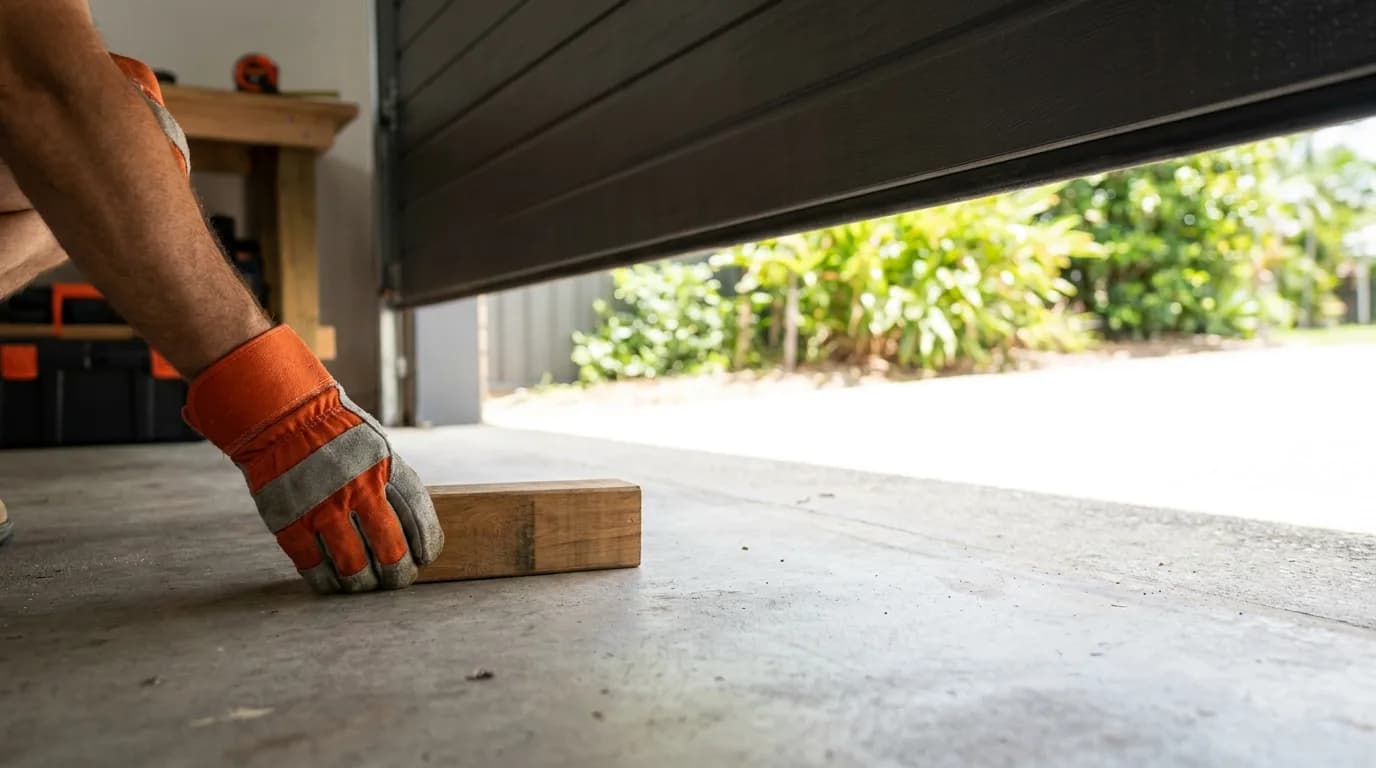
The balance and spring items are the ones that pay for the visit. Run our 60-second safety test yourself before you book and you'll walk into the conversation already knowing whether your door holds its position — which is the single most useful thing you can tell us.
What do you do the morning after?
First: don't operate a door that's visibly been hit. Dented curtains, bowed panels, a bent track, a door sitting crooked in its opening — none of that fails politely, and a stressed door under an unbalanced load can come off its tracks with one press of a button. If it looks wrong, leave it and call.
Second: photograph it before anything gets touched. Wide shots showing the door and the house, close shots of every dent, and shots of the tracks or guides if they're distorted. Insurers ask, and a photo taken before a repair is worth more than a description afterwards. We can document damage and cause as part of the job — what's covered is between you and your insurer, and we won't pretend to know your policy.
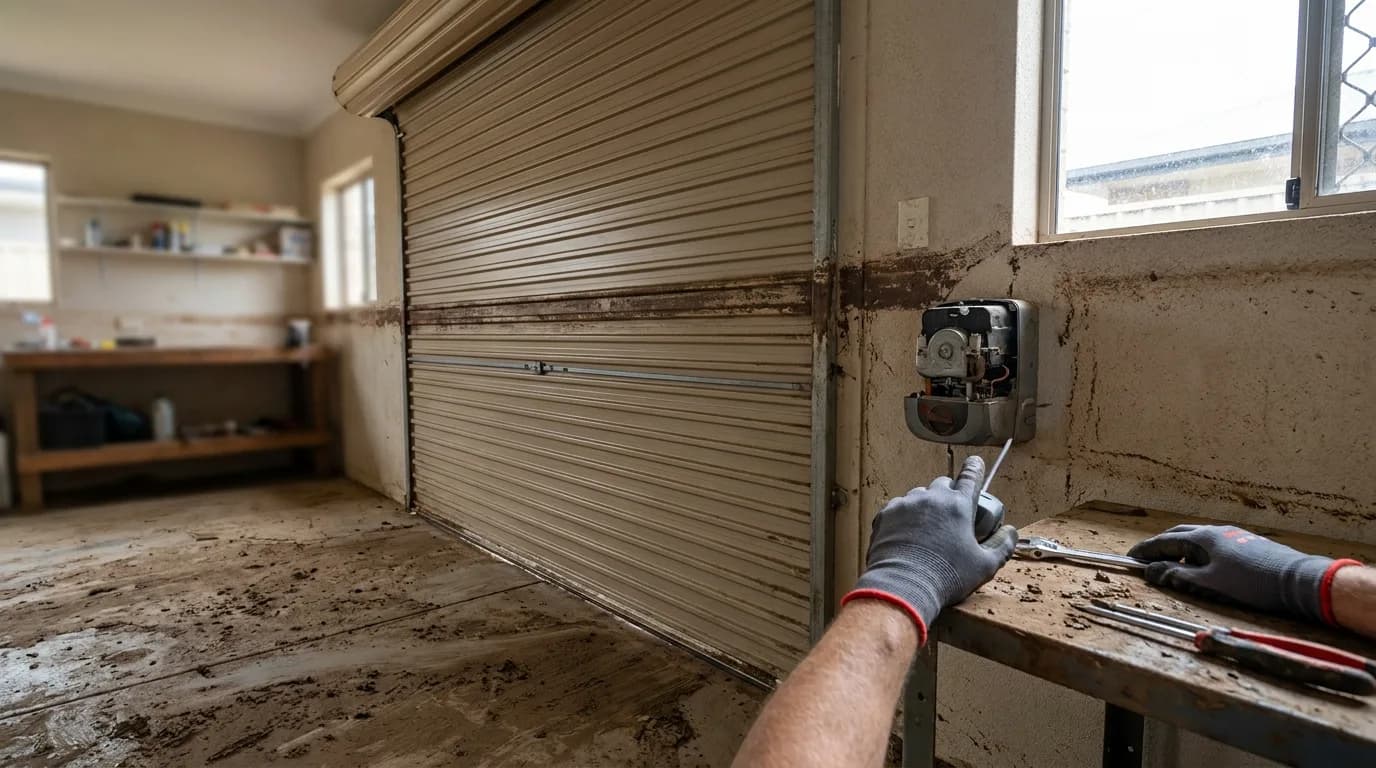
Third: if water got into the garage, stop and read our guide on a flooded garage door motor before you press anything. A motor that's been in floodwater is a shock and fire risk, not an inconvenience.
What can't wait until Monday?
A door stuck open is a security problem you can't leave overnight, and it's the most common storm call we get — often because the power came back and the motor stopped mid-cycle with the limits scrambled. A door hanging out of its tracks is a falling hazard. A door with a bang and a heavy feel is a broken spring and needs to be left alone until someone with the right gear arrives. All three are what our 24/7 emergency garage door line is for, and yes, that includes the public holiday when the storm inevitably lands.
If it's September or October, book the service now while the calendar's open. If it's January and there's a mess in your driveway, call Core Garage Door anyway — a real person answers, we'll make it safe first, and the quote is free before anything gets touched.