The 60-Second Garage Door Safety Test Every Brisbane Home Should Do
Your garage door is the largest and heaviest moving object in your house, it operates several times a day, and the people most likely to be standing under it are the ones least able to get out of the way. That's the entire argument for this article. It takes a minute, you need one piece of scrap timber, and it tells you something you genuinely don't otherwise know: whether your door will stop.
Most people have never tested theirs. Not out of negligence — because it works, so it seems fine. But safety systems are the only part of a machine that fail silently. A door with a dead auto-reverse behaves identically to a door with a working one, right up until the day it doesn't. Let's find out which one you own.
What safety systems does your door actually have?
A modern setup has two independent layers, and they work in completely different ways.
The first is force sensing, built into the motor. The unit knows how much effort a normal cycle takes, and if the current it's drawing spikes — because the door has hit something — it reverses. It's a contact system: something has to be touched before it triggers. The second layer is the photo-eye pair sitting either side of the opening, a hand's width off the slab, with an invisible infrared beam between them. Break the beam and the door refuses to close, or reverses if it's already moving. That one is non-contact: nothing has to be touched at all.
Photo-eyes are standard on new installations and we'd fit them to anything without them. But plenty of Brisbane garages are running motors old enough to predate them entirely — particularly under-house tilt doors on Queenslanders in the character suburbs, where the door and the motor have been quietly doing their job since before anyone thought about beams. If yours has no sensors, the force system is the only thing between the door and whatever's underneath it, and it becomes twice as important that it works.
How do I test the auto-reverse?
This is the one everybody should run, and there's a right way and several wrong ways.
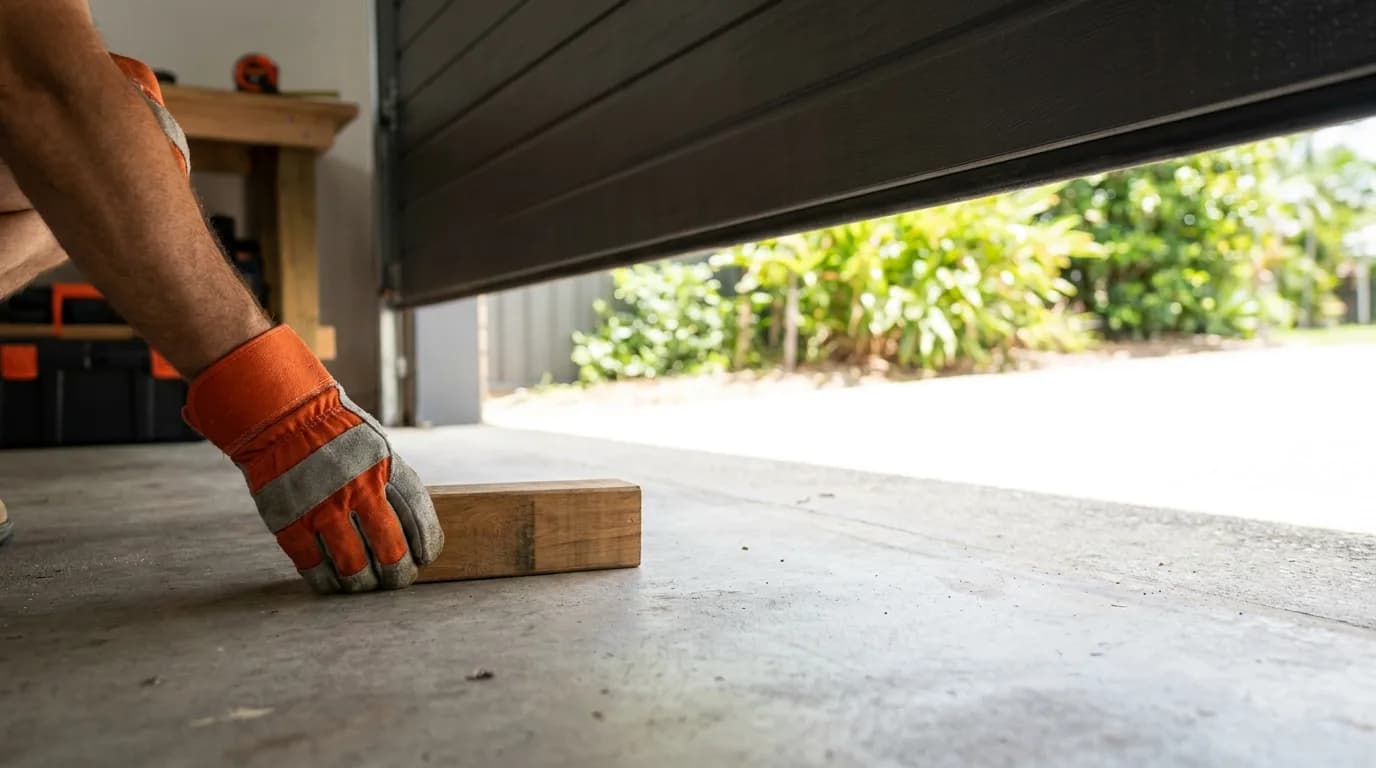
- Get a solid timber offcut — a short length of 70x35 is ideal. Lay it flat on the slab, directly in the door's path.
- Stand clear. Close the door with the wall console, not the remote, so you're in the garage and away from the opening.
- Watch what happens when the door touches the timber. It should make contact, then reverse promptly and travel back to fully open.
- That's a pass. Anything else is a fail.
A fail looks like: the door contacts the timber and simply stops, sitting there. The door contacts it and keeps pushing. The door hesitates, then continues. Any of those means the force setting is wrong, the system isn't sensing properly, or someone has wound the force up in the past to stop a door reversing. All three need a technician.
And the wrong ways, because they matter. Never use your foot. Never use your hand. Never use a person, at any age, for any reason. Never use a rolled towel or a cardboard box — they compress, so the door crushes them without ever generating the resistance spike it's meant to detect, and you get a false fail that sends you looking for a fault that isn't there. Solid, low, flat, and not attached to anyone.
How do I test the photo-eye sensors?
Easier and faster. Start the door closing from the wall console, then pass a broom handle through the beam at ankle height, well across the opening from where you're standing. The door should reverse immediately, without touching the broom handle at all — that's the point of a non-contact system.
If it doesn't reverse, the beam isn't doing its job. Before you assume a fault, check the obvious: wipe both lenses with a soft dry cloth, look for a cobweb across one, and check the indicator LEDs. And use the broom handle rather than your leg. The whole reason to test a safety system is that you're not certain it works.
While you're down there, note where the sensors sit. They're at ankle height because that's the height that matters, and it's also the height that gets hit by bikes, bins and mowers — which is why sensor alignment is the single most common thing our garage door repairs technicians correct, and why a door that opens perfectly but refuses to close is nearly always this and nothing else.
How do I do the balance test?
This is the one that tells you about your springs without going anywhere near them, and there's one rule that makes it safe: do it with the door closed.
With the door fully down, pull the manual release cord — the red handle on the motor rail — to disconnect the door from the drive. Now lift by hand, slowly, to about waist height, and let go. A correctly balanced door holds its position exactly where you left it. It should also have lifted with roughly one hand's effort.
The reason to start closed is simple and important: a closed door can't fall. If you pull the release with the door open and a spring has already failed, the door comes down. Closed first, every time.
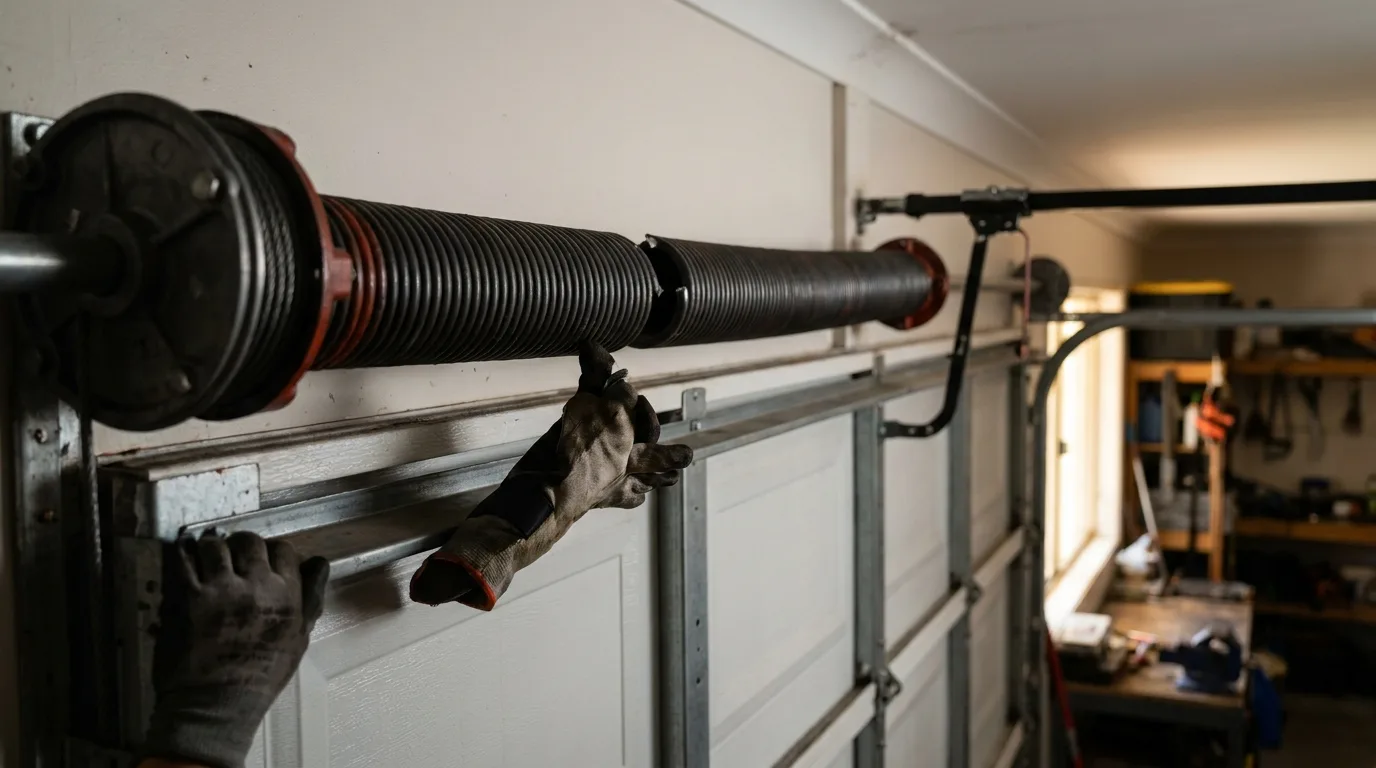
A fail here reads clearly. If the door sinks or slams when you let go, the springs are fatigued and no longer carrying the door's weight — the motor has been quietly making up the difference and it will fail early because of it. If the door pulls itself upward out of your hands, it's over-sprung. If it fights you from the first centimetre, or feels immovable, stop right there: that's a broken spring, and it's the point where this article stops giving instructions. Don't adjust anything, don't try to help it. That's a garage door spring and cable call, and why we're so firm about that is worth two minutes of your time.
When you're done, re-engage the trolley before you walk away, or you'll spend tomorrow morning listening to a motor run while the door does nothing.
Should I turn the force up to make it close?
No. This deserves its own heading because it's the most common well-meant mistake in the whole subject. If your door reverses when it shouldn't, the force setting is not the problem — it's the thing telling you there is a problem. Winding it up doesn't fix a door. It raises the amount of weight the motor is allowed to bring down on whatever's under it, and it deletes the layer of protection you just spent a minute testing.
A door that suddenly needs more force needs it because something got harder to move: dry rollers, a track knocked out of line, a spring losing tension, a door drifting out of balance. Every one of those is a real fault with a real fix, and every one gets worse. Turning the number up buys silence, not safety. Setting force and limits correctly to a specific door is part of every garage door motor job we do, and it's done after the mechanical problem is sorted, not instead of it.
How often should I run this — and how often should the door be serviced?
Run the three tests monthly if you're organised; realistically, tie it to something you'll remember. When the seasons turn is a good anchor, and September or October is the best one of the lot — that's the window before Brisbane's storm season gets going in November, when everyone's calendar is still open. Our storm season checklist covers the rest of that pre-season list.
Professional servicing runs on a different clock, and where you live changes it. Inland and western suburbs, annually is a reasonable rhythm for a domestic door. Bayside — Wynnum, Wellington Point, Cleveland, Redcliffe — two to four times a year is closer to honest, because salt air works on springs, bearings, fixings and guides continuously and it doesn't take a year off. Commercial doors cycle many times more than a home door and are a maintenance schedule rather than a repair schedule entirely.
What other habits are worth the same minute?
- Keep the manual release handle reachable for an adult and out of reach of a child standing on something.
- Remotes are not toys and shouldn't live where small hands find them.
- Nobody rides the door. Not once, not for a photo.
- Don't leave a remote in an unlocked car parked in the driveway — that's a house key with buttons.
- Watch the door all the way down. The habit of pressing and driving off is how a half-closed door goes unnoticed for a whole day.
If your door fails any of these three tests, don't adjust it — book it. Call Core Garage Door and we'll test the auto-reverse, balance the door properly, set the limits and force to what your door actually needs, and give you a free on-site quote before we start.