Why Garage Door Springs Are the One Repair You Should Never DIY
There's a Saturday-morning logic to it that's hard to argue with. The part is available over the counter. There's a video. You've done harder jobs than this on the car. It's a spring — how bad can it be?
We're a garage door company and we'll happily tell you which jobs you can do yourself. Sensors, remote batteries, cleaning tracks, lubricating hinges, testing your own auto-reverse — all yours. This one isn't, and it's not because we want the work. It's because a garage door spring stores enough energy to put a grown adult in the emergency department in a fraction of a second, and it's holding that energy right now, with the power off and the motor unplugged.
What does a garage door spring actually do?
Start with the physics, because everything else follows from it. A sectional or roller door is heavy — heavy enough that lifting one by hand, unassisted, would be a serious effort. Yet a properly set up door lifts with about one hand. That gap is the spring's entire job.
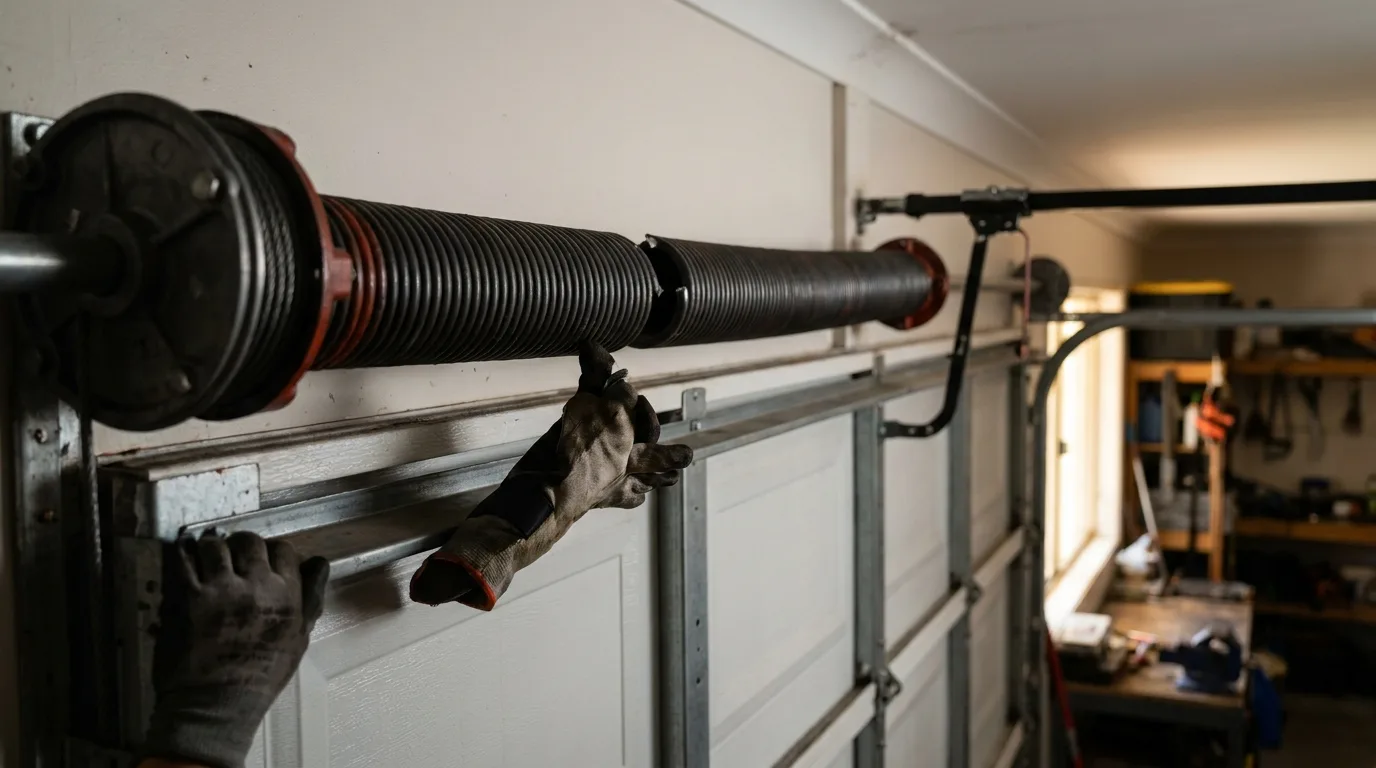
On a sectional door, a torsion spring sits on a shaft above the opening, wound to a specific number of turns. That wind-up torque runs out along the shaft to cable drums at each end, and the lift cables run from the drums down to brackets at the bottom of the door. As the door drops, the cables unwind the drums and wind the spring tighter — the door is storing its own weight in the spring as it closes. As it rises, the spring gives that energy back. The system is a battery made of steel.
Roller doors do the same trick differently: the spring lives inside the barrel the curtain wraps around, out of sight. Extension springs, on older setups, stretch alongside the tracks instead of twisting. Same principle, same stored energy.
And this is the part worth sitting with: your motor is not lifting your door. It never was. It's overcoming friction and nudging a near-weightless load. Which is exactly why a broken spring immediately becomes a motor problem, a cable problem and a track problem in quick succession.
How do I know if my garage door spring is broken?
Recognising it is genuinely useful, so here's the full list. Any one of these is enough to stop using the door.
- A bang like a gunshot from the garage, usually at rest and often overnight — a fatigued spring is under full load whenever the door is closed, and cold nights tighten it further.
- A visible gap in the coil of the spring above the door. If you can see daylight in the middle of a coil that should be continuous, the diagnosis is finished.
- The door has suddenly become extraordinarily heavy by hand — not gradually heavier, suddenly heavy.
- The motor hums or strains and the door doesn't move, or moves a few centimetres and gives up.
- The door lifts crooked, one side lagging behind the other.
- A lift cable hanging slack, bunched, or jumped off its drum.
- The door drops fast and lands hard instead of settling.
If you've got any of that, the safest thing your door can do right now is nothing. Leave it exactly as it is, keep everyone out from under it, and call. That symptom set is what our broken spring and cable replacement service exists for, and it's also the single most common after-hours call on our 24/7 emergency line.
Why are torsion springs so dangerous?
Because the energy doesn't care about anything you've done to make the situation feel safe. This is the misconception that hurts people: they kill the power, unplug the motor, pull the release cord, and reasonably conclude the door is now inert. But the power was never holding the spring. The spring holds itself, permanently, until something lets it go — and that something is either a technician with the correct bars and the correct sequence, or it's an accident.
The energy in a wound torsion spring is controlled by set screws clamping a winding cone to a shaft, and by the bars in that cone. When any part of that arrangement goes wrong — a bar that's the wrong diameter and slips, a screwdriver used where a bar belongs, a cone that spins on a worn shaft, a hand in the path — the entire stored charge leaves in a fraction of a second through whatever is nearest. That's how people lose fingers, break wrists and hands, take a bar to the face, and put holes in plasterboard. We're not going to describe the sequence here, because describing the sequence is how someone decides they now know it.
There's a second trap on sectional doors: the bottom bracket. That bracket, at the bottom corner where the cable attaches, is under full cable tension whenever the door is closed. It looks like an ordinary bit of hardware with ordinary bolts. It isn't. Undoing it with the door down is a classic and very serious amateur mistake.
Isn't an extension spring safer?
It's less concentrated, and it's still not safe. An extension spring under tension that lets go becomes a whip travelling the length of the garage, broken end leading. That's precisely why safety containment cables run through the centre of extension springs — so the pieces stay threaded on the cable instead of touring the room. If you have extension springs and can't see a cable through them, that's worth a look on its own merits.
Roller door barrel springs get their own warning, because they're the sneakiest of the lot. They're hidden inside the barrel, so there's no visible coil to inspect and no visual warning before failure — the only symptom you get is a door that's been getting heavier for months. Same stored energy, no early warning, and the re-tensioning process is exactly where the amateur injuries happen. That's a roller door technician's job with the right gear.
Why can't I just buy the part and fit it?
Set the danger aside for a second and look at it as a purely technical question, because the sizing alone rules most people out. A replacement torsion spring is specified by wire diameter, inside diameter, overall length and wind direction — and get the wind direction wrong and you've bought a paperweight. Those four numbers together define how much lift the spring produces per turn, and that has to match the actual weight and the actual travel of your specific door.
Not a door like yours. Yours. A double sectional with timber-look cladding weighs differently to the identical shell in plain steel. An insulated panel is heavier than a single-skin one. A door carrying three coats of paint added over twenty years is heavier than it left the factory. This is why we weigh and measure rather than reading a spring off a chart — a chart-sized spring gives you a door that's permanently slightly wrong, and a slightly wrong door chews through springs, motors and rollers for the rest of its life.
The spring itself is the cheap part. The tools, and knowing what to do with them, are the job.
Why do springs have to be replaced in pairs?
Because springs are rated in cycles, not years, and both of yours have done the same cycles. When one fails, the other one has been through everything the first one has — it's not healthy, it's just next. Fitting one new spring alongside a fatigued one leaves the door unbalanced, loads the new spring with weight it wasn't sized to carry, and reliably produces a second call-out within months. Doing both at once is cheaper than doing it twice, and it's the difference between a repair and a patch.
Brisbane makes this worse. Humidity keeps a film of moisture on bare steel, and near the bay salt turns that film into an electrolyte — every pit corrosion puts into a spring is a stress riser, and stress risers are where springs break. Doors in Wynnum and Cleveland get through springs faster than the identical door in the western suburbs, which is why galvanised options are a genuine conversation there rather than an upsell.
Doesn't a licence make this legal to DIY?
You'll see it claimed online that garage door work legally requires a QBCC licence in Queensland, full stop. That's not accurate as a blanket statement — QBCC licensing is threshold-based, and the threshold for building work is $3,300 including GST. Plenty of garage door repairs sit under it.
We point that out because we'd rather be straight with you than scare you with a rule that doesn't say what people claim it says. The reason not to touch a spring has nothing to do with paperwork. The spring doesn't know about licences, thresholds, or how careful you're being. It knows about stored energy, and it releases all of it at once. Being careful is not a substitute for the right bars and the right sequence.
Can I still get my car out?
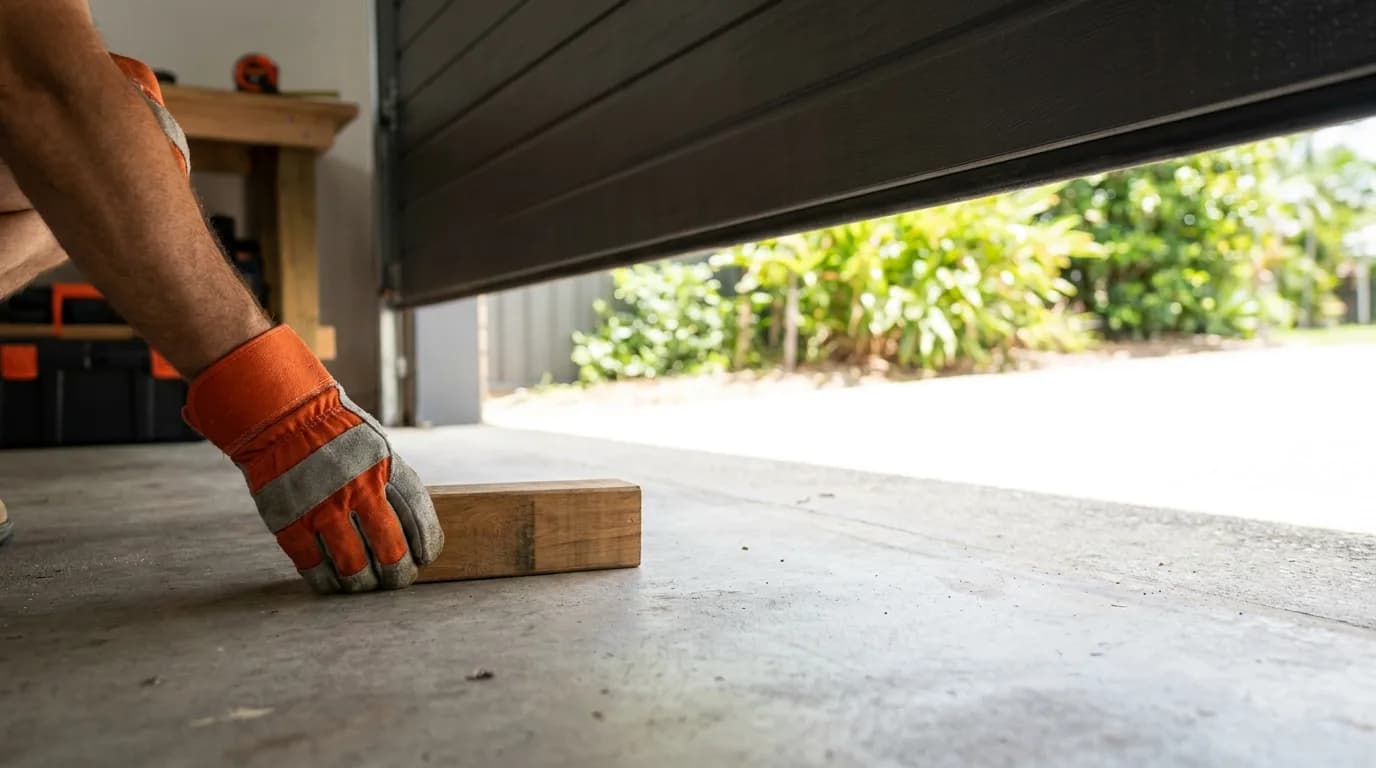
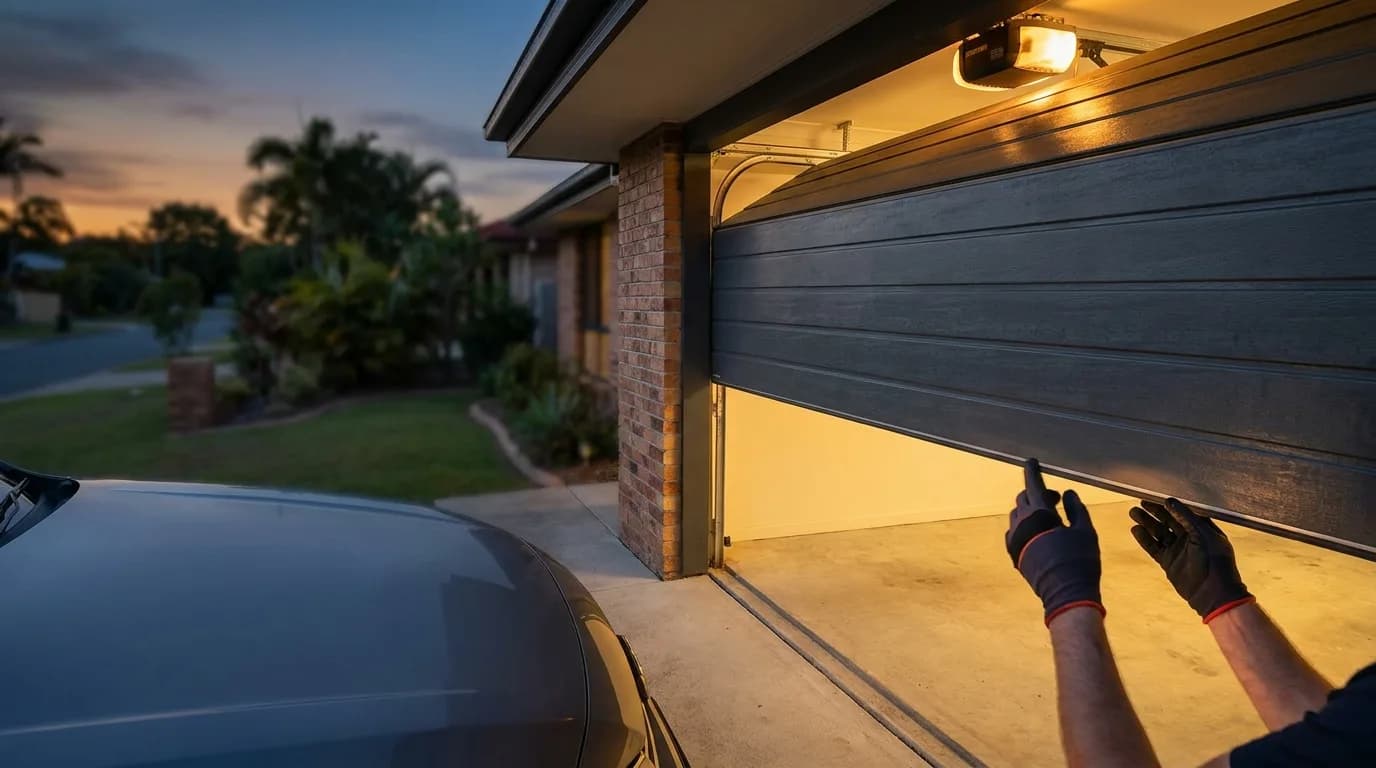
Sometimes, carefully. Pull the manual release with the door closed and test the weight with a gentle lift. If it comes up with modest effort the failure may be partial and you can get the car out — but put the door back down, and don't run the motor. If it fights you, feels immovable, or wants to run back down the moment you ease off, stop. A door with no counterbalance comes down hard and doesn't care what's underneath. And never prop it: a timber offcut under a door held up by nothing isn't a plan, it's a delay.
What does a proper spring replacement involve?
In the order we do it: identify the spring type and system, measure wire size, inside diameter, length and wind, and establish the door's real weight and travel rather than assuming. Replace in pairs, with the correct bars and the correct technique. Inspect what failed alongside it — cables, drums, bearings, the centre plate and the shaft, because they take the shock of a spring letting go and they fail from the same causes. Then re-balance the door until it holds anywhere in its travel, reset the motor's force and limits to the new balance rather than the old, test the auto-reverse against a timber offcut, and cycle it repeatedly before we leave. If you'd like to check that last part yourself between services, our 60-second safety test walks you through it.
If you heard the bang, or your door has suddenly gone heavy, don't spend the afternoon researching winding bars. Call Core Garage Door — day, night or public holiday — and we'll come to you anywhere in Greater Brisbane, size it to your door, and quote you free before anything is touched.