Why Won't My Garage Door Close? The Six Real Causes
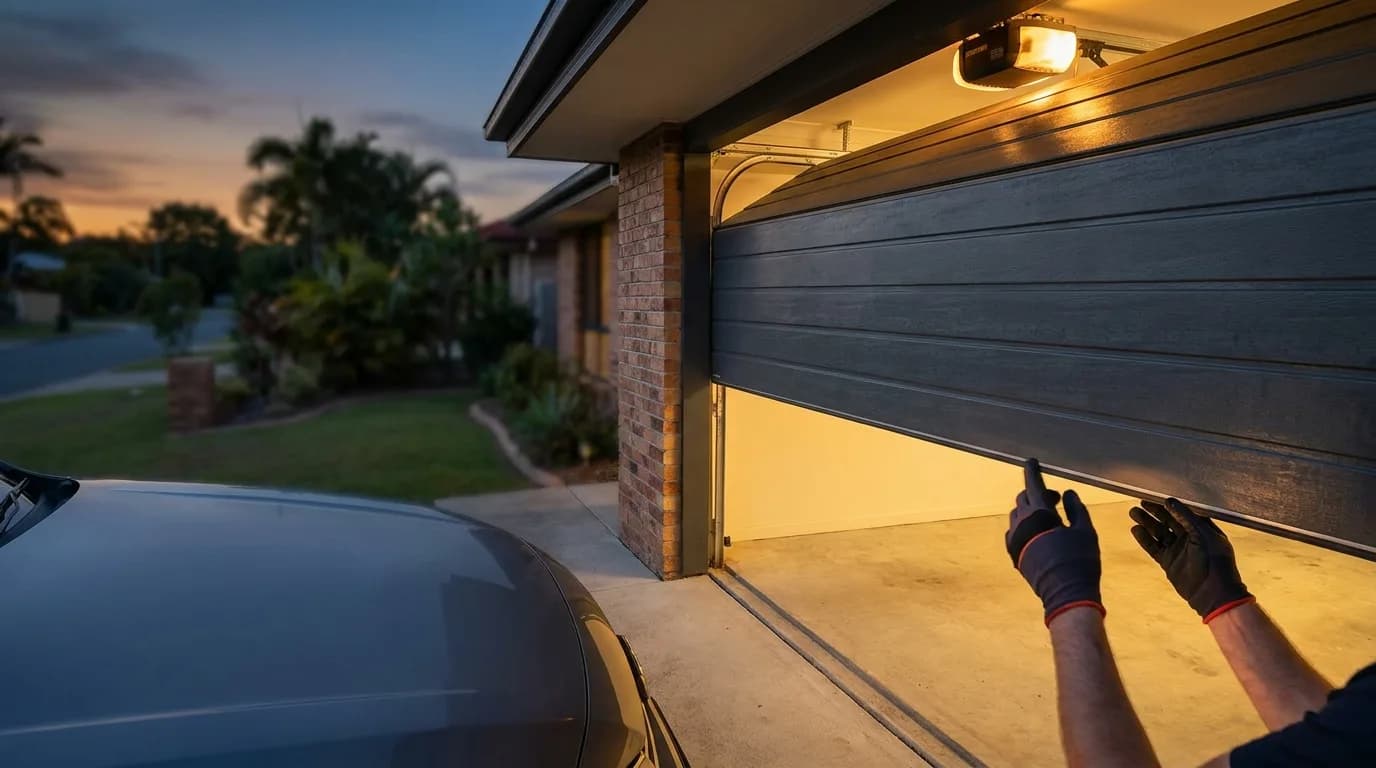
It's late, you're standing in the driveway, and the door won't go down. You press the button and the motor runs — then the door stops halfway, or touches the slab and runs straight back up, or doesn't move at all while a light on the head unit flashes at you. Everything you own is behind that opening and you can't just walk away. It's one of the most common calls we take across Greater Brisbane, and one of the most misdiagnosed.
Here's the single most useful thing to know before you touch anything: a door that won't close is almost never a dead motor. The motor is the part everyone blames and it's usually the part doing its job properly. Modern openers are built to be suspicious — they refuse to close when something tells them not to. Work out what they're suspicious of and you've solved the problem. These are the six causes we actually find, roughly in the order we find them.
Is your door refusing to move, or closing and reversing?
Split the problem in half first, because these are two different faults. A door that travels down then runs back up is being told to stop by a safety system — a photo-eye beam, a force limit, or a real obstruction. A door that doesn't move at all is a different animal: power, a manual lock, a control input, or a mechanical failure that has it jammed solid. If yours won't move in either direction, our companion piece on what to do when a garage door won't open works through that side.
One more free diagnostic before you climb a ladder. Watch the courtesy light on the motor head when you press the button. Nearly every unit sold here — Merlin, Chamberlain, B&D, ATA, Centurion — flashes that light or an LED in a repeating pattern when it refuses a command, and the pattern is a fault code. Count the flashes before you call.
Cause 1: Are the safety sensors blocked or out of alignment?
This is the winner by a mile. Two small units sit either side of the opening, a hand's width above the slab, with an invisible infrared beam between them. Break that beam and the motor refuses to close — but it will still open perfectly, and that asymmetry is the signature. If your door opens beautifully but won't close, look at the sensors first.
They live at ankle height, which is exactly where a bike pedal, a wheelie bin or a mower handle knocks them out of aim. In Brisbane there's another culprit: spiders — a web across a lens does the job as well as a solid object. And on a west-facing garage, low afternoon sun striking the receiver lens can wash the beam out entirely, which is why some doors only misbehave between four and six o'clock.
Most sensors carry a small LED on each side — typically one shows power and the other confirms it can see its partner, so a flickering or dead indicator means blocked, misaligned or unpowered. Wipe both lenses with a soft dry cloth, clear the beam path, and if one has been knocked in its bracket, nudge it gently back until the indicator settles. If the wiring has been chewed or pulled out, stop there — that's ours.
Cause 2: Is there something in the tracks you can't see?
The motor doesn't know the difference between a child and a pebble. Anything that makes the door harder to move spikes the current the motor draws, and the moment that spike crosses the force threshold the unit assumes it has hit something and reverses. That is the auto-reverse safety function working exactly as designed.
What causes the spike is rarely dramatic. A screw or a stone in the track. A bottom rubber that has curled under and catches on a lifted edge of the slab. A roller that has developed a flat spot and skips rather than rolls. On a roller door, a slat that has bowed slightly and fouls in the side guide. Run your eye along both tracks and look for bright rub marks on the metal — that's where the door has been fighting something, and it's the map of the fault.
Cause 3: Has the close limit drifted?
Your motor doesn't see the floor. It's told once, at install, how far to travel to reach the closed position, and it counts its way there. Set that limit too far and the door reaches the slab before the motor thinks it's finished — so it keeps driving, feels the concrete resisting, and reverses, because as far as it's concerned it just hit an obstruction mid-air. The tell is unmistakable: the door touches down and bounces straight back up, at the same point, every time.
Limits drift as a chain or belt stretches, and they can be lost outright after a power surge or a control-board reset — which in Brisbane means after storm season. Resetting them is brand-specific, and it has to be done together with the force setting rather than instead of it: part of every garage door motor call we do.
Cause 4: Is the force setting fighting a binding door?
Force is how hard the motor is allowed to push before it decides it has hit something. It's a safety threshold, not a nuisance dial. Which brings us to the worst advice on the internet: if your door reverses, wind the force up until it stops. Please don't. You haven't fixed a door — you've raised the weight the motor may bring down on whatever's underneath, and deleted the protection standing between your door and a child, a bonnet or a dog.
If your door needs more force than it used to, something has got harder to move, and that something is the actual fault. Dry or collapsing roller bearings. A track knocked out of alignment. A spring quietly losing tension. A door drifting out of balance so the motor now carries weight the springs should. Every one of those gets worse, and every one is what our garage door repairs service is there to find.
Cause 5: Is the door locked, or is a control stuck on?
Two embarrassingly simple ones we get called out for constantly. First, the manual lock: plenty of roller doors and older sectionals have a centre bolt or side locks, and if somebody threw them before a holiday and forgot, the motor strains against a bolted door and gives up. Second, the wall console — many units have a vacation or lock switch that disables the remotes entirely, which is a quiet way to convince yourself every remote died at once. Look at both before you look at the electronics.
Cause 6: Has a spring or a cable failed?
This is where the safe checks stop, and it's the cause you most need to recognise. The springs — the torsion spring on the shaft above the opening, or extension springs alongside the tracks — carry the entire weight of the door. The motor's job is to nudge a balanced door, not lift a heavy one. When a spring goes, the door's full weight lands on a machine never designed to hold it.
The signs are consistent. A bang like a gunshot from the garage, often overnight, sometimes hours before the door ever misbehaves. A visible gap in the coil of the spring above the door — if you can see that gap, the diagnosis is finished. The door suddenly feeling extraordinarily heavy by hand. The motor humming and straining without moving anything. One side of the door sitting higher than the other. A lift cable hanging slack or bunched on its drum.
If that describes your door: stop pressing the button, don't force it, and don't stand under it. Every extra cycle drives a broken system further out of alignment and can pull the door off its tracks. That's what our garage door spring and cable replacement service exists for, and why it's a technician's job rather than a Saturday project is laid out in why springs are the one repair you should never DIY.
What can you safely check yourself?
All of this is fair game, and costs nothing but ten minutes:
- The switchboard — a storm can trip the safety switch on the circuit your motor lives on without taking the rest of the house out.
- The remote battery, and whether the wall console works when the remote doesn't.
- The manual lock or centre bolt — make sure nobody has thrown it.
- The lock or vacation button on the internal wall console.
- Both sensor lenses: wipe them clean, clear the beam path, check the indicator lights.
- The tracks and the bottom seal for anything caught, curled or wedged.
- The flash pattern on the motor's light when it refuses — write it down before you call.
And that's the list. Springs, cables, drums and the tensioned side of the system aren't on it, and never will be.
What does a technician actually do?
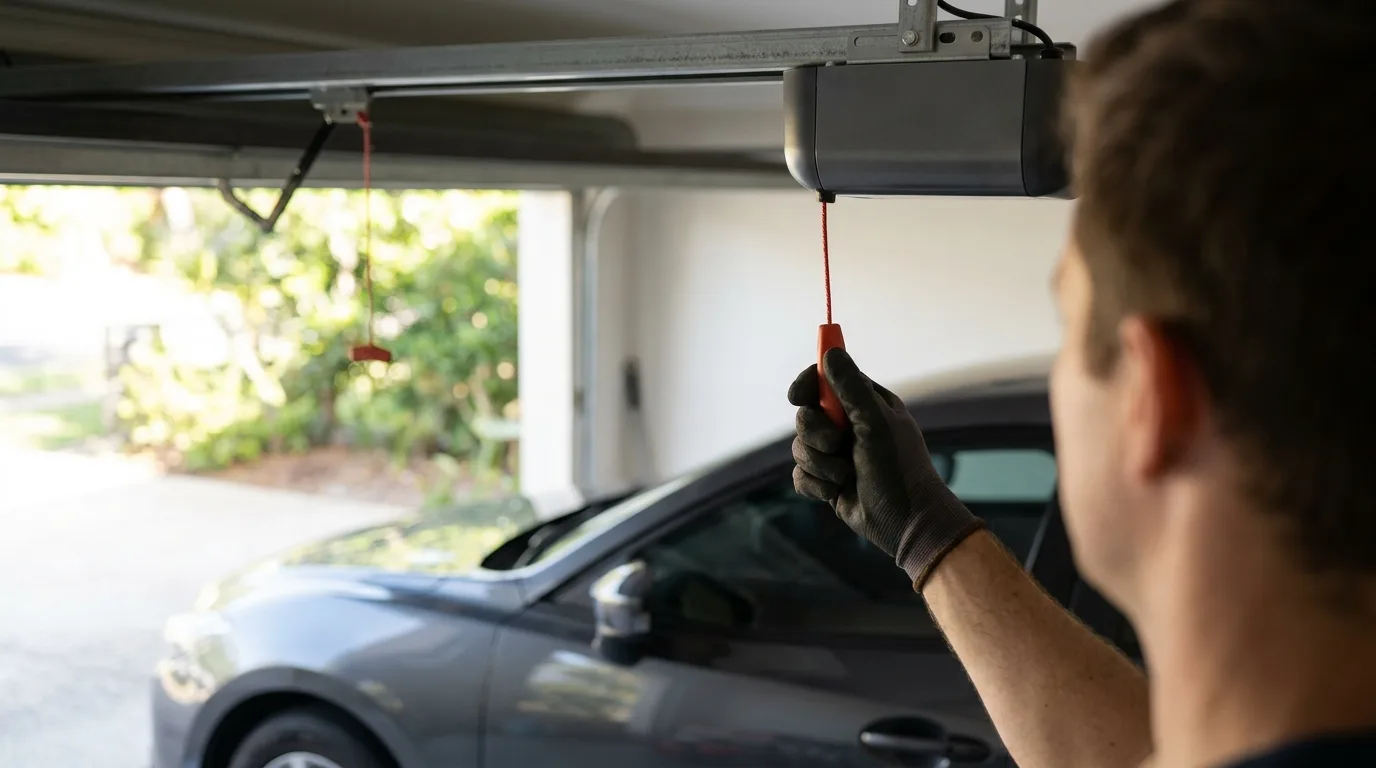
The first thing we do is take the motor out of the equation: pull the manual release and move the door by hand. Half the faults blamed on electronics are mechanical, and a door tells you the truth the moment the motor stops speaking for it. A correctly sprung door lifts with about one hand's effort and holds its position anywhere in its travel. If it slams or fights, the door is the problem and the motor was just the messenger.
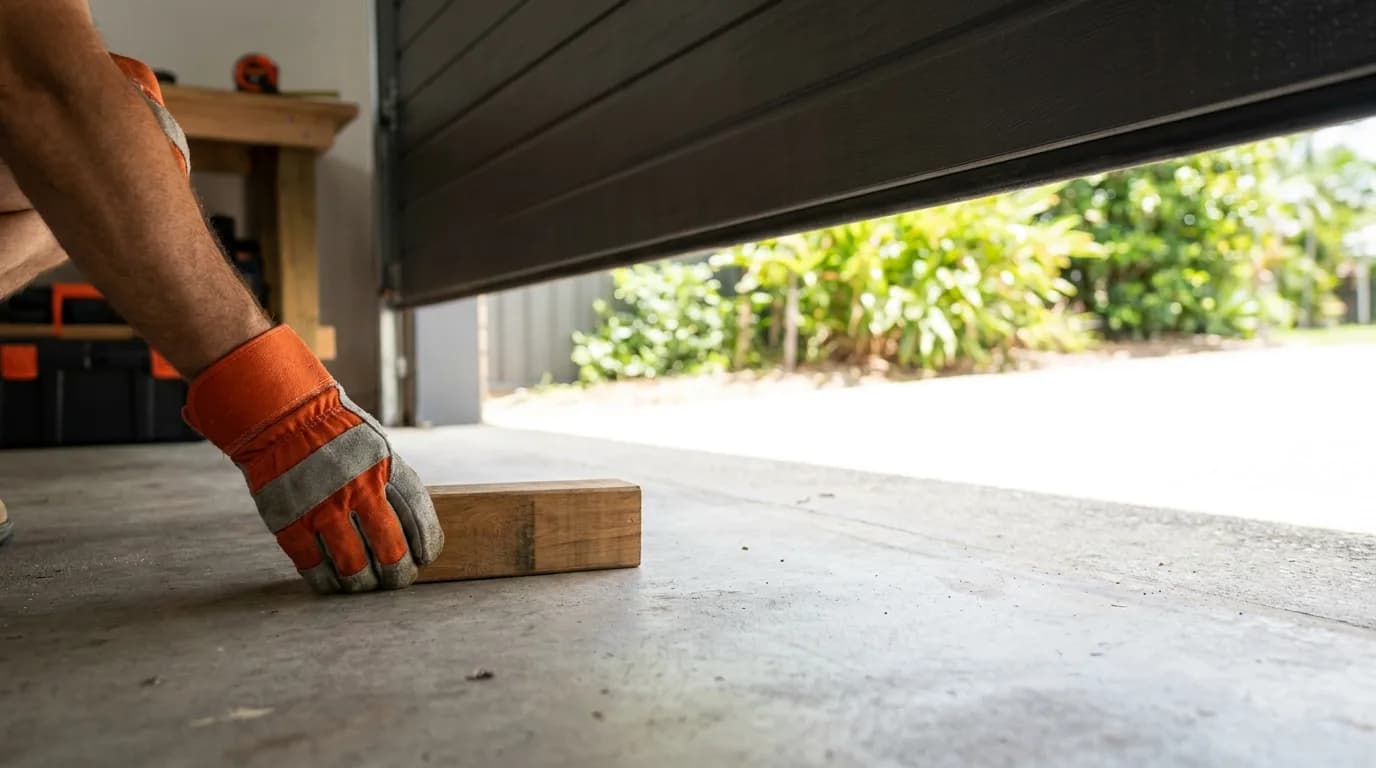
From there: spring condition and tension, cables and drums, roller and bearing wear, track alignment checked against a level rather than by eye, sensor aim and voltage, then limits and force reset to your specific door instead of a factory default. Last, the auto-reverse gets tested against a solid timber offcut and the door cycled repeatedly — a fault that only shows on the fourth cycle is still a fault.
When should you stop and call?
Stop after two or three refusals. A door that won't close won't be argued into it, and repetition is what turns a sensor problem into a track problem. Stop immediately if the door is sitting crooked, if you heard a bang, if the motor hums without moving, or if anything is grinding. And treat a door stuck open as what it is — a security problem you can't leave overnight, which is why our 24/7 emergency garage door line has a real person on it at 2am.
If your door won't close anywhere in Greater Brisbane, call Core Garage Door. Tell us what it does, where it stops and what the light is flashing, and we'll diagnose the actual cause and quote you free before anything gets touched.