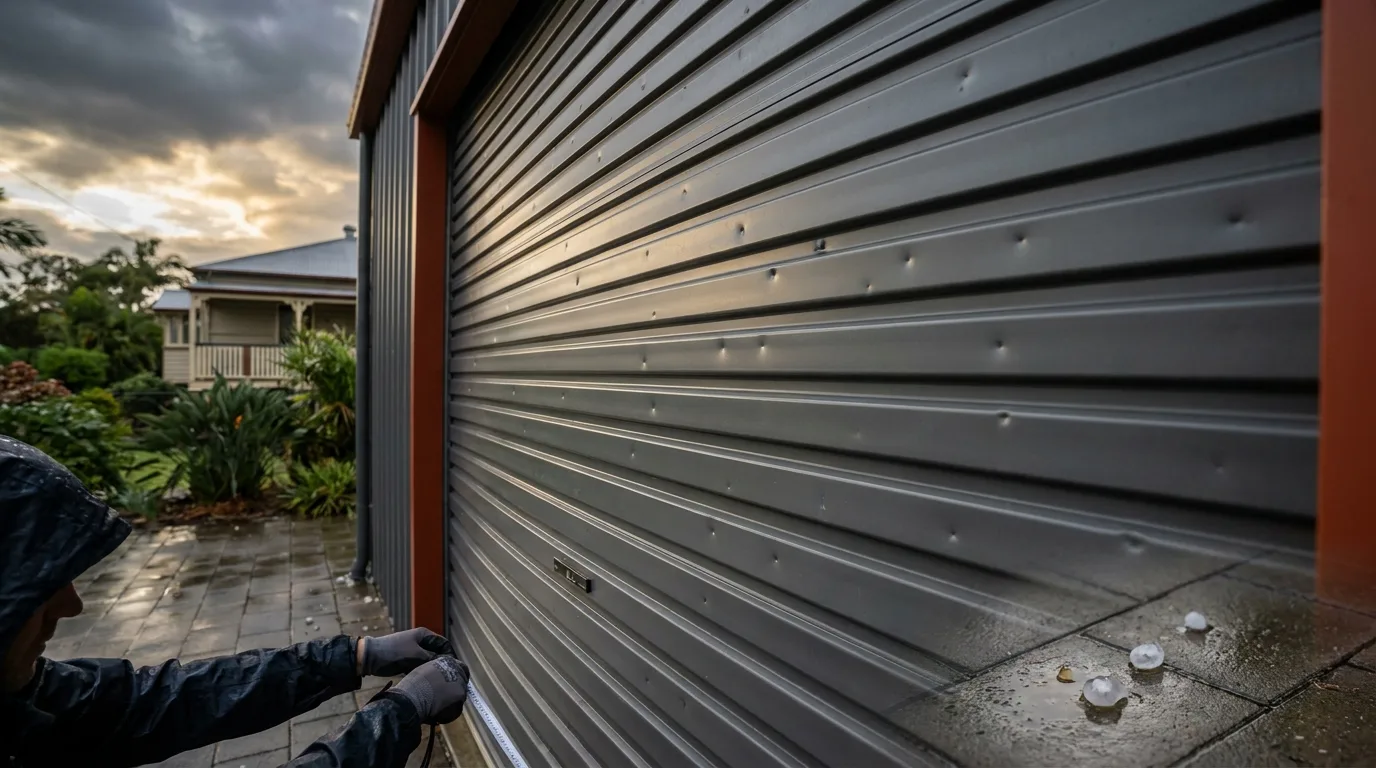
Salt Air Is Eating Your Roller Door: A Bayside Brisbane Guide
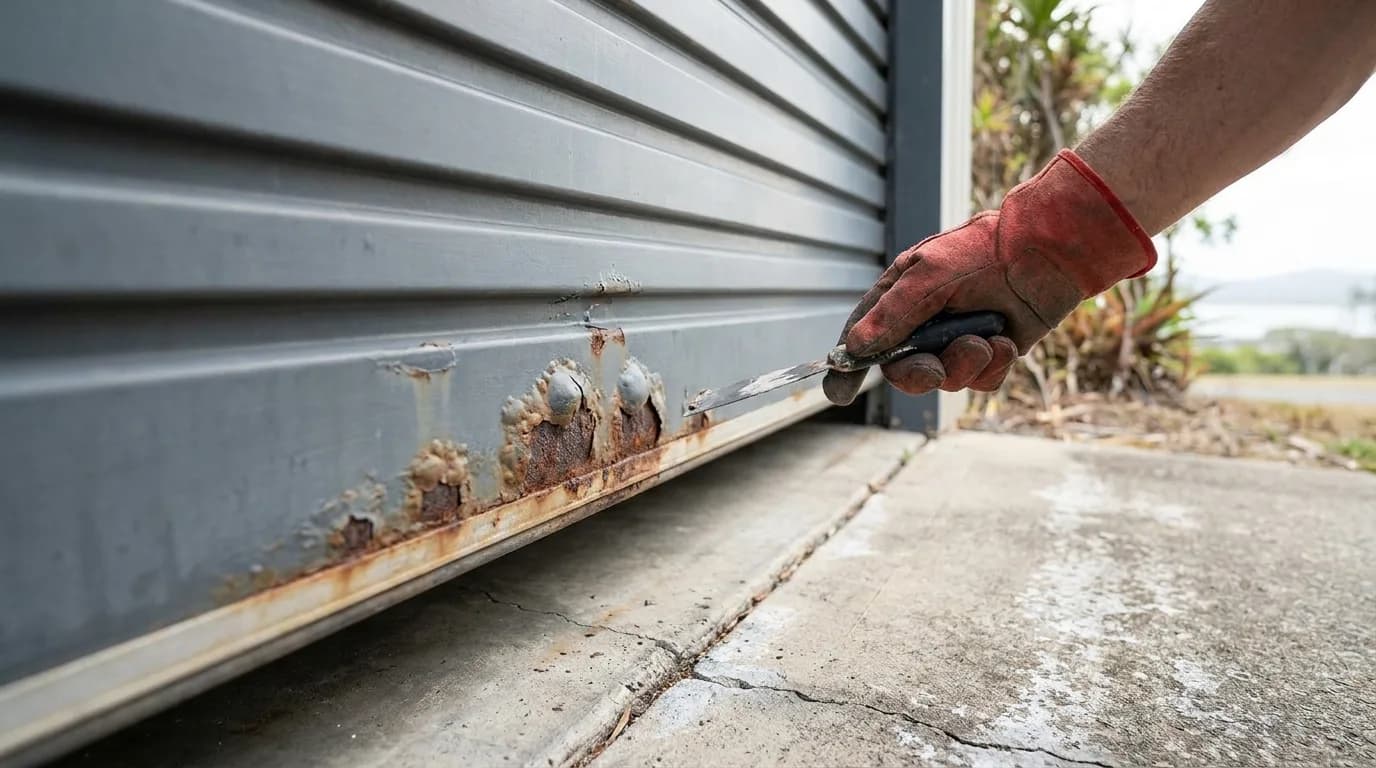
You've noticed it start at the bottom. A blister in the paint along the rail, a chalky bloom on the lower slats, a rust line following the edge where the curtain meets the guide. The door still works, so it goes on the someday list. Then one winter the door gets heavy, or a slat starts catching, and someday arrives with a call-out attached.
If you live anywhere on Brisbane's bay side, your door is in a fight it doesn't advertise. It's not a fair fight and it never stops. Here's what's actually happening to your roller door, which parts go first and why, and what genuinely slows it down — as opposed to what people tell you slows it down.
How far inland does salt air actually reach?
Further than most people assume, which is the first thing worth correcting. Marine aerosol — microscopic salt droplets thrown up by breaking water — doesn't stop politely at the foreshore. On the onshore easterlies that Brisbane gets for large parts of the year, it rides kilometres inland, settling on everything it passes over.
So the obvious ones are obvious: Wynnum, Manly, Wellington Point, Cleveland, Redcliffe, Victoria Point. But the doors we see with the same corrosion pattern sit well back from the water — Tingalpa, Capalaba, Thorneside, the streets behind Lota. Those homes don't think of themselves as coastal. Their hardware disagrees. Meanwhile the identical door in Kenmore or The Gap, on the other side of town, will outlive it comfortably. Same brand, same install, same year, very different lifespan.
That's not a marketing line. It's the reason a bayside door needs a different servicing rhythm and different hardware choices than the same door twenty kilometres west.
What does salt actually do to a steel roller door?
Here's the mechanism, because it explains everything that follows. Your door is steel with a protective system on it — galvanising, then a coating. That protection works by keeping oxygen and water away from the steel and, in the case of galvanising, by sacrificing zinc before the steel goes.
Chloride ions break that arrangement down. They attack the passive layer, they get under coatings at any scratch or cut edge, and they accelerate the whole reaction. But the truly nasty property is this: salt is hygroscopic — it pulls moisture out of the air. A salt deposit sitting on your door doesn't need rain to do damage. It drags water out of Brisbane's humidity and holds a thin wet electrolyte film against the steel, overnight, every night, long after the last shower.
That's the insight people miss. It isn't the rain that kills a bayside door. Rain, at least, washes salt off. It's what the salt does in the dry days between rain events — a corrosion cell quietly running under a dew film at 3am, night after night, on a door that looks perfectly dry when you back out at seven.
Two extra mechanisms make it worse. Crevice corrosion: wherever slats interlock, wherever the curtain sits in the guide, under the bottom seal, behind a fixing — moisture and salt wick in, and can't get out or get washed. Those crevices stay wet when the flat faces are bone dry. And galvanic corrosion: put dissimilar metals together with a salt electrolyte between them, which is the description of most door hardware, and one of them corrodes preferentially.
Why does the bottom of the door always go first?
Because the bottom of the door lives in the wet zone and everything else doesn't. The bottom rail sits against a slab that stays damp long after the surface looks dry. Rain splashes back off the driveway onto the lowest 200 millimetres. The bottom rubber traps a film of water against the rail rather than shedding it. The cut edge of the curtain at the rail is bare steel by definition — a coating can't cover a cut you made after coating it. And your door spends most of its life closed, so that lowest section is the only part permanently sitting in that environment.
Then people add to it without meaning to. The mower throws wet grass at it. The irrigation sprays it every second morning with water that never gets wiped off. The pressure washer strips the coating off the very edge that needed it most. If your door is failing at the bottom and looking fine at the top, none of that is bad luck — it's the exact place all of the water is.
The good news is that a bottom rail is a separate component. It can be replaced on its own, which is one of the most common jobs our roller door technicians do on this side of town, and it's a much smaller conversation than a new door.
What's happening inside the barrel where you can't see?
This is the part that catches people out, because the door looks fine and then one day it's too heavy to lift.
Inside the barrel that your curtain wraps around is the spring that counterbalances it. It's steel, it's lightly protected at best, and it has never been washed by anything in its life. Salt-laden air moves freely into the barrel through the open ends, settles on the coils, and does exactly what it's been doing to the outside of your door — except in there, nothing ever rinses it off, and nobody ever looks.
Every corrosion pit on a spring surface is a stress riser: a tiny concentration point where the load isn't shared evenly. Springs fail at stress risers. That's why a bayside door doesn't slowly warn you — it delivers a barrel spring that gets through its cycles years early and then stops carrying the curtain. The symptom you actually notice is a door getting progressively heavier over months, and by then the corrosion has been going on for years. The barrel bearings and axle pins go the same way, which is where the squeal and eventually the grind come from.
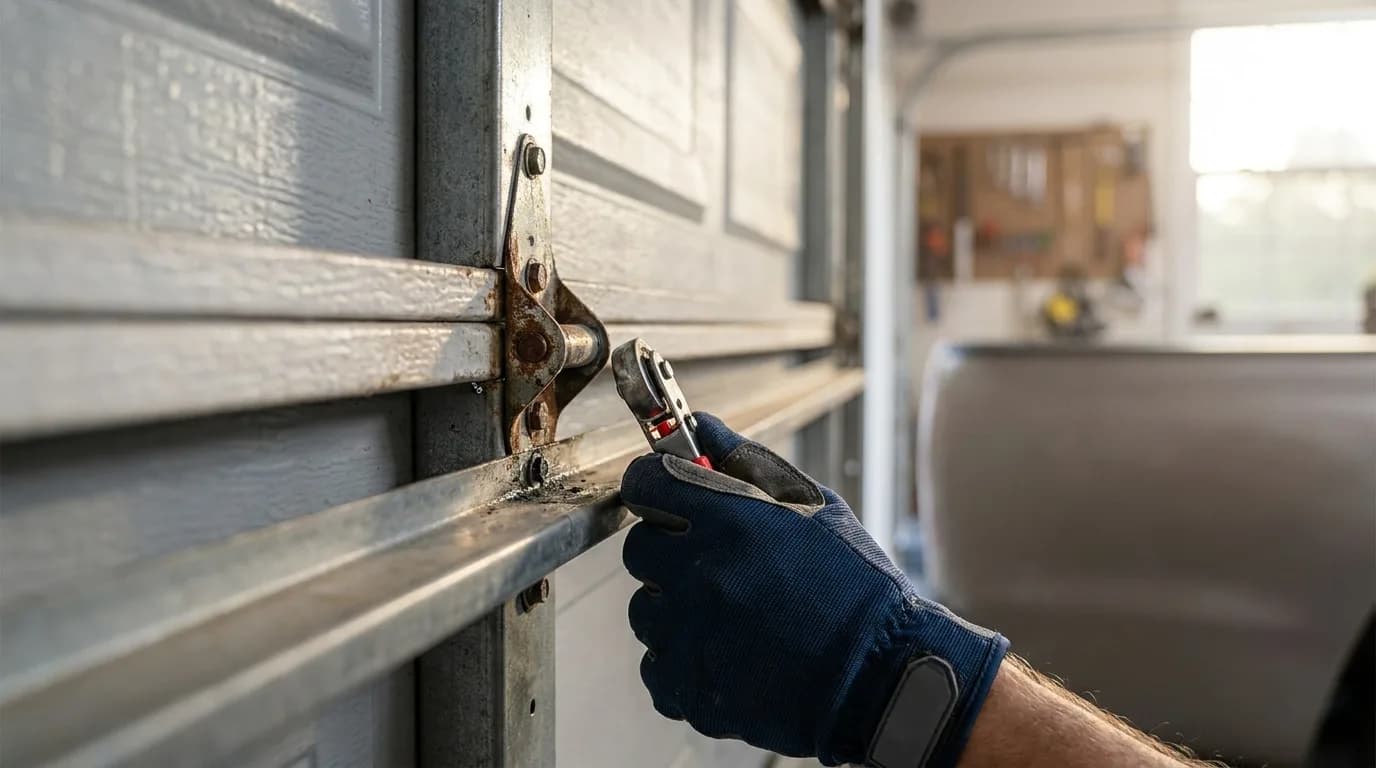
That, plus the guides. Rust roughens the inside of a guide channel, a curtain that used to slide starts to bind, the motor pushes harder against the friction, and the extra force bows the curtain — which makes the binding worse. It's a loop, and it ends with a door jumping its guide. Bayside springs and cables are frequent flyers on our spring and cable replacement service, and galvanised options are a real conversation here rather than an upsell.
Can I wash it off, and how often?
Yes, and it's the highest-value thing you can do for free. Fresh water is the antidote — the entire problem is a salt deposit, and rinsing removes the deposit.
- Rinse both faces of the curtain with fresh water, not just the street side. The inside collects salt too.
- Flush the guides out — that's where salt sits in a crevice and never leaves on its own.
- Get under the bottom rail and behind the bottom seal, which is where the water was always going to be.
- Wash the sheltered areas hardest. This is counterintuitive: the parts under an awning or a deck never get rain-washed, so they accumulate salt indefinitely while the exposed parts partially self-clean.
- Mild detergent and a soft cloth or sponge, then rinse. No abrasive pads, no harsh solvents, no aggressive pressure washing — stripping the coating to remove the rust is trading a stain for a hole.
- Roughly monthly in the marine zone, and always after a strong easterly blow, which deposits a season's worth in a day.
It's ten minutes with a hose. It won't stop corrosion, but it changes the rate materially, and rate is the whole game here.
Do I need a new door, or just the bottom rail?
The honest answer depends on where the rust has travelled, and it's a genuine fork rather than a sales question.
If the corrosion is confined to the bottom rail and the seal, that's a component swap and the curtain is fine. If it has moved up into the slats themselves — bubbling paint two or three slats up, perforation you can feel with a fingernail, edges going lacy where they sit in the guide — then the curtain is the problem and replacing the rail is putting a new tyre on a bent wheel. And once slats have perforated, the door has lost strength it needs when a summer storm leans on it, which stops being a cosmetic question.
We'll tell you which one you've got. A door with a rusty rail and sound slats is worth repairing all day. A curtain that's gone through isn't, and pretending otherwise just books you a second call-out.
What should you specify on a bayside replacement?
If you're replacing a door within a few kilometres of the water, this is the one chance you get to change the outcome — the specification decides the next fifteen years, not the servicing.
Talk to us about coastal-rated coating systems rather than the standard finish, and about the Colorbond ranges intended for higher-exposure environments. Ask about hardware: fixings, brackets, guides and bearings in materials chosen for the exposure rather than whatever came in the box, because a coastal-grade curtain hanging on standard hardware fails at the hardware. Ask about spring options — galvanised makes real sense here. And ask what the manufacturer's warranty actually says about proximity to breaking surf, because coated steel warranties commonly carry distance-based conditions and it's much better to read that before you choose than after. All of that gets covered properly at the measure-up for a new roller door installation.
How often should a bayside door be serviced?
Two to four times a year, rather than the annual rhythm that suits an inland door. That's not padding — salt works on the parts you can't see, continuously, and a service visit is the only time anybody looks inside a barrel or at a cable's strands. The failures we're describing all announce themselves months in advance to someone who's looking. Alongside that, run our 60-second safety test yourself between visits, and get familiar with what your door normally sounds like — the noises it makes are the earliest warning you'll get.
If your door has rust at the rail, a guide that's started catching, or it's simply getting heavier every year, call Core Garage Door. We work the bayside constantly, we know which parts corrode first out here, and we'll give you an honest free quote on whether it's a rail, a curtain, or a door.