What Your Noisy Garage Door Is Actually Telling You
A garage door is the loudest thing your house does. It's also the most honest. Every noise a door makes is a specific part telling you something specific, and if you learn to read them you get weeks or months of warning before a breakdown — which is the difference between a booked service and a 6am call with your car locked in.
The most useful thing to notice isn't how loud it is. It's the rhythm. Does the noise happen once per cycle, at the same point in the travel? Repeatedly, at a steady beat? Constantly, the whole way? Only on the way down? Only when it's cold? That pattern narrows the fault faster than anything else, so pay attention to when, not just what.
Why is my garage door making a grinding noise?
Grinding is metal being destroyed by metal, and it's the noise that earns a phone call soonest. There are four usual suspects and they're easy to tell apart by location.
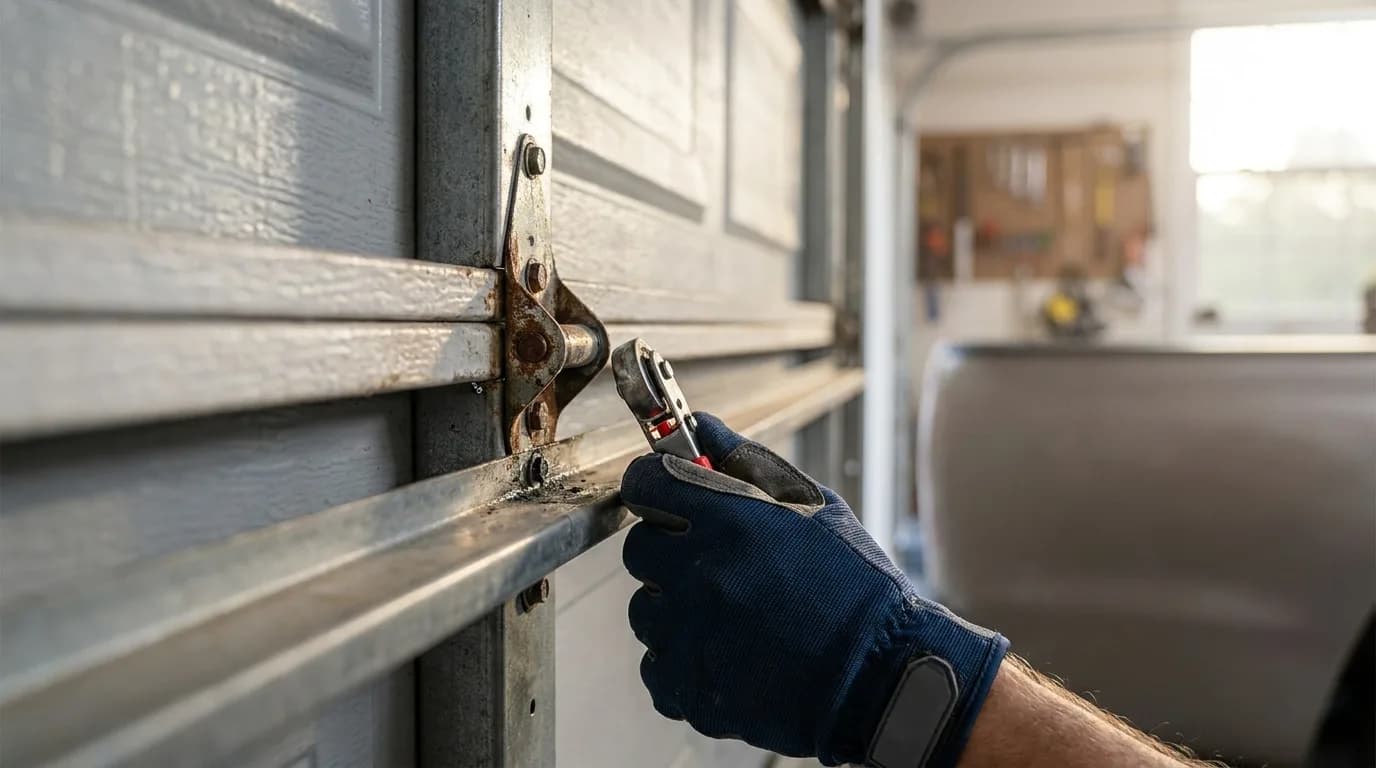
A roller whose bearing has collapsed stops rolling and starts dragging, so its stem grinds along the track — you'll hear it move down the wall with the door, and you'll find a bright polished streak on the track where it's been scraping. A shaft bearing at the end plate above the door, dry or failed, grinds from up high on one side and doesn't travel. On a roller door, grinding down one guide is a curtain binding — usually a bowed slat, often a souvenir of someone reversing into it. And a grinding note from inside the head unit itself, with the door slowing or stopping, is a drive gear stripping.
None of these are cosmetic. A dragging roller wears a groove into the track, and a grooved track eventually stops guiding the door at all — which is how a cheap roller becomes an off-track door on a Sunday night. This is the bread and butter of our garage door repairs service, and it's dramatically cheaper to catch at the noise stage than at the failure stage.
What does a screeching or squealing door mean?
Screeching is friction without lubrication: dry roller bearings, dry hinges, dry track pivots. It's the most common noise in Brisbane, and our climate is the reason. Humidity, dust and salt strip lubricant off steel faster than a dry inland climate does, and the standard homeowner response makes it worse.
That response is a can of penetrating spray. Please don't. General-purpose penetrating fluid is a solvent — it dissolves the lubricant that's already there, flashes off, and leaves the surface bare and sticky with dust. Worse, people spray the track. Rollers are meant to roll along a track, not slide, and a lubricated track surface just makes them skid and flat-spot. Lubricant belongs on hinge pins and roller bearings, not on the running face of the track.
Hinges and roller bearings, done with a proper garage door lubricant, are a fair homeowner job. The springs and the shaft above the door get done as part of a service by someone standing on a ladder who knows what's under tension up there — that's a line worth keeping.
Why does my door bang or thump rhythmically?
A repeating beat means something round has a flat spot on it, and the beat rate tells you which round thing. A fast tick that speeds up as the door speeds up is a roller with a flat or a chipped bearing race. A slower, heavier thump is more likely a drum or the shaft. A single bang at the same height every cycle isn't rotational at all — that's a track joint, a bad splice, or a bent lip that the door has to jump each pass.
Rhythmic noise is also the classic symptom of a door that has drifted out of balance. When the springs stop carrying their share, the door loads and unloads the hardware differently through the travel, and the whole assembly starts talking. If the noise arrived at the same time as the door feeling heavier by hand, that's not a hardware problem — that's a spring problem wearing a hardware costume.
What was that bang like a gunshot?
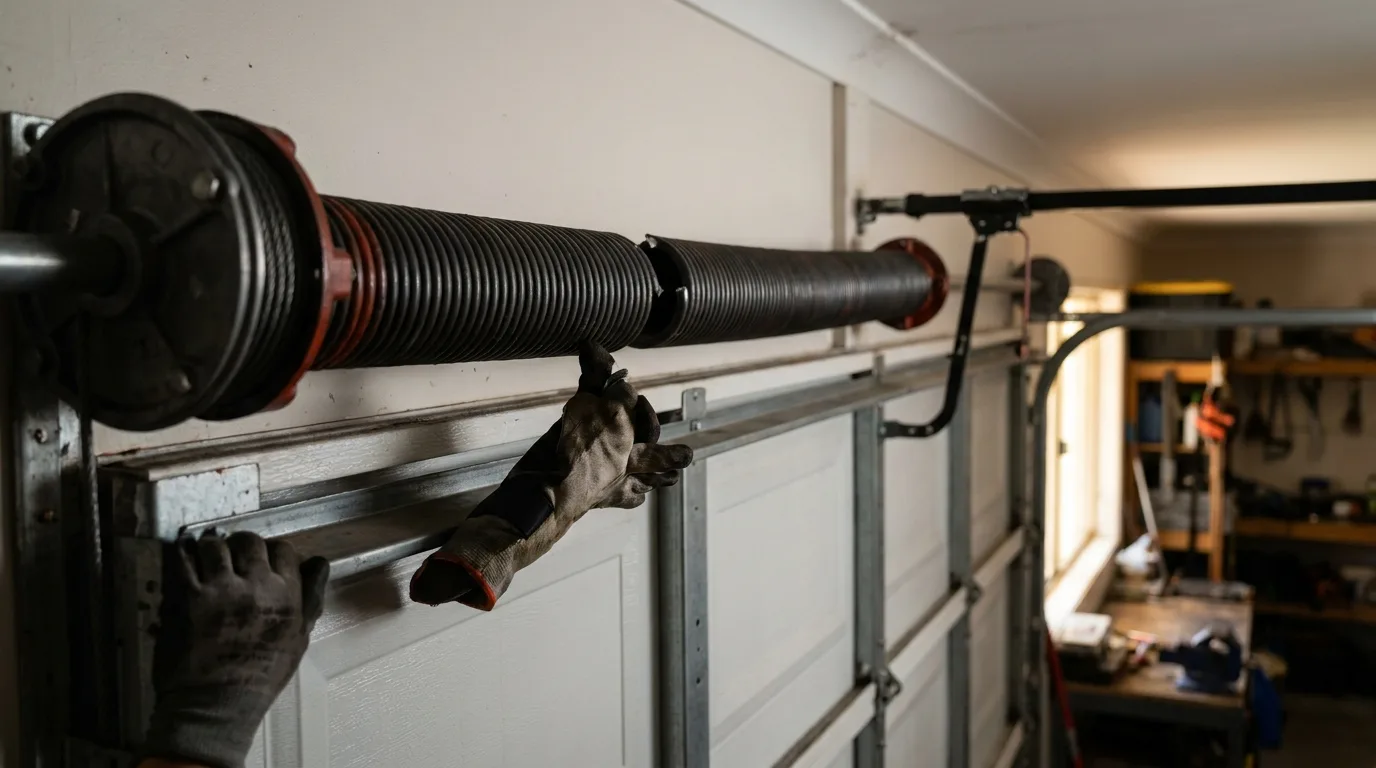
You'll know it when you hear it, and it's usually not while the door is running. People describe it as a gunshot in the garage, often at night, often when nobody's near it — and then the door is fine the next morning until they try to use it. That's a torsion spring letting go, and it happens at rest because a fatigued spring is under full load the entire time the door is closed. Cold nights make it more likely: steel contracts, tension climbs, and a spring that's been counting down for years picks that moment.
After the bang, the door will be extremely heavy by hand, the motor will hum and strain, and you may see a visible gap in the coil above the door. Don't run it. Don't try to lift it and prop it. A door with no counterbalance is a very large weight held up by nothing much, and our garage door spring and cable technicians would much rather come out to a broken spring than to a broken spring plus a door pulled off its tracks by three more attempts. The full case for leaving it alone is in why springs are the one repair you should never DIY.
Why does my roller door rattle and drum?
Roller doors have their own vocabulary. A rattle in the wind is a curtain sitting loose in its guides — often because the guide inserts have worn, or a guide has been knocked out of parallel, or the curtain has bowed slightly so it no longer sits square across the opening. A drumming boom in a southerly is that steel curtain acting as a very large speaker cone, which is annoying but tells you the same thing: it's not held snugly.
The reason to bother fixing it is that a loose curtain wears its guides, and worn guides let the curtain move further, and eventually the door jumps a guide and jams half open. Guides, curtains and bottom rails are exactly what our roller door service carries for the common Australian profiles, and near the bay there's a corrosion angle on top — salt roughens the inside of a guide and the curtain starts binding where it used to slide.
Is a humming, vibrating motor normal?
A quiet hum while running is normal. A hum with no movement is a spring, as above. A vibration you feel through the ceiling is usually mounting: the head unit's fixings have worked loose in the rafter, or the unit is bolted rigidly to a timber that happily resonates. In a lot of newer Brisbane builds there's a bedroom or a media room directly above the garage, and that structure carries every cycle straight into the room. Anti-vibration mounts and, where it's warranted, a belt drive instead of a chain will transform that — it's one of the more satisfying things our garage door motor technicians get to fix, because the customer notices every night.
Chain slap — a loose, slappy rattle up at the rail — is chain tension, and it's an adjustment rather than a replacement. Left alone, a slack chain accelerates sprocket and gear wear, which is how you get back to grinding.
Which noises mean stop using the door now?
- A bang like a gunshot, then a heavy door — a spring has failed. Stop.
- A hum or strain with no movement — the motor is carrying weight it can't carry. Stop.
- Grinding from the head unit with the door slowing — a gear is stripping. Stop.
- Any noise combined with the door lifting crooked or one side lagging — cable or spring. Stop.
- A metallic snap followed by a door that slams down — assume a cable. Stop, and stand clear.
Everything else — screeching, rattling, chain slap, a thump you've learned to live with — is a booking rather than an emergency. But it is a booking. Noise is the cheap version of the problem; silence after a failure is the expensive version.
If your door has started saying something new, tell us what it sounds like, where it comes from and when in the cycle. Call Core Garage Door for a free on-site quote and we'll find the part that's talking before it stops talking and starts breaking.